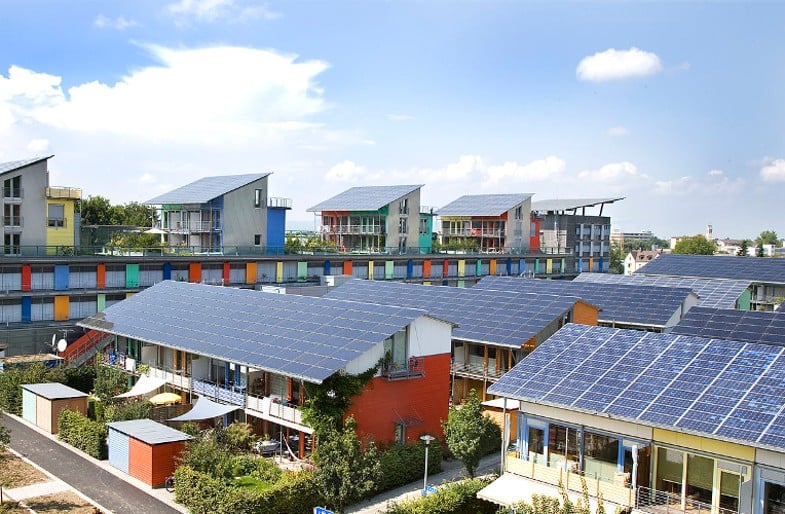

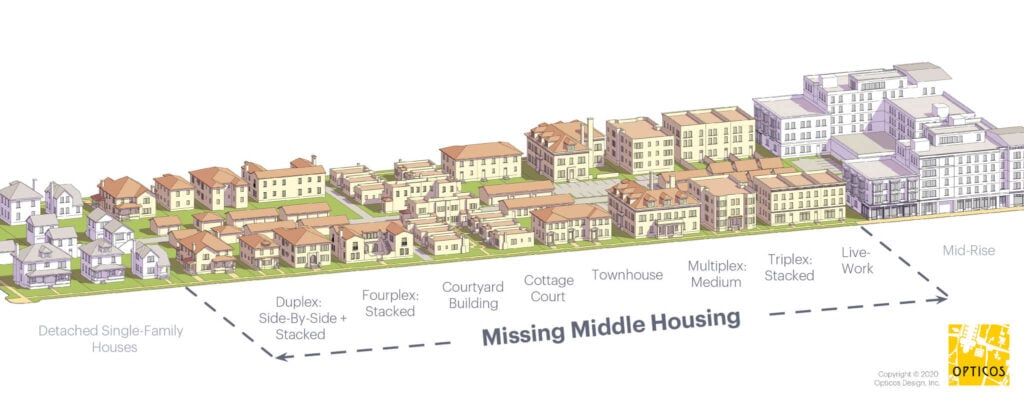
Middle housing types are duplexes, triplexes, fourplexes etc, townhomes & row houses, cottage clusters and courtyard buildings.
The name 'Middle Housing' was coined in 2010 by architect Daniel Parolek who identified that the middle housing types were missing in modern design & permitting. American cities were only permitting single family homes & high-density apartment blocks. Parolek’s book The Missing Middle successfully advocated to reinstate the missing middle housing types. The goals are to increase affordability & increase density to make more vibrant & walkable neighborhoods.
The Washington State legislature passed HB1110 in 2023 and cities in Washington State are now required to permit middle housing in areas previously zoned 'residential'. This means building in backyards.
It's important to note that the new Middle Housing Bill only legislates that middle housing be built in cities, not beyond city-limits in the counties.
Large cities (75000 inhabitants or more) must permit more dwellings on a single lot, up to a 6-plex. The small cities (25000 inhabitants or less) are only required to permit duplexes.
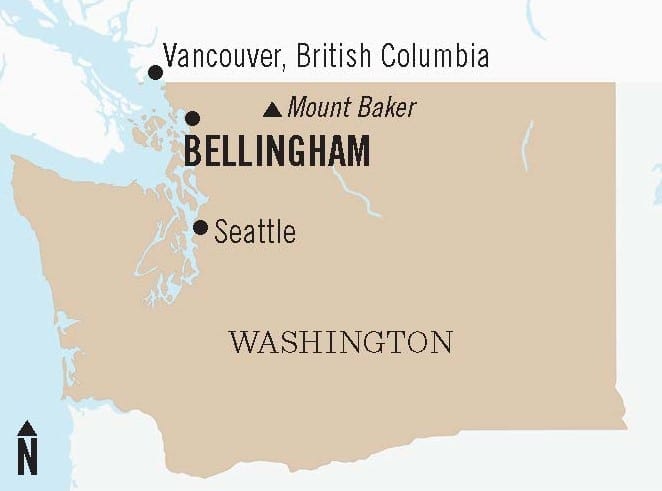
Can I Build Middle Housing in Bellingham?
Middle housing can be permitted & built in Bellingham on lots zoned 'residential', effective Dec 8th, 2025. The key ordinance can be found here.
Bellingham is a city of 97000 people and this permits the development of 4 middle housing units per lot, plus it's possible to permit an additional 2 units per lot if those units are affordable for 50 years, or the lot is located within 1/2 mile walking distance from a major transit stop.
Importantly the original house on a lot does not have to be demolished, and that house does not count towards the unit total.
Middle housing units can all be subdivided or condominiumized from each other & the original house (if it was kept), allowing middle housing units to be bought & sold.
The Middle Housing code contains some surprising details: the only parking requirement is one ADA-accessible parking spot per project, setbacks have been reduced, sub-standard streets may need to be improved, and middle housing is prohibited within the Lake Whatcom watershed to protect the reservoir.
NOTES: Middle Housing in Bellingham is called Infill Housing. Chapter 20.28 BMC explains the details, but be aware that the 20.28 code has not been updated to incorporate the 2025-12-35 ordinance and if there are contradictions, the 2025-12-35 ordinance has seniority. For clarity, this article will continue to use the phrase Middle Housing.
Also, it's important to know that the Middle Housing code in Bellingham is a work-in progress and will be reviewed December 2026 for effectiveness.
Who Needs Middle Housing?
Housing shortages are nationwide but extreme in Bellingham. There is little unused land in Bellingham and the Middle Housing code creates many new opportunities to build new homes on existing lots.
Once enough new homes are built, we expect to see rents & house prices stabilize.
First time buyers will appreciate the wider diversity of choice created by middle housing development: With many units at or below 1000sf, the cost to buy a low-rise home in a walkable neighborhood will become more manageable.
Also, the creation of more small homes will help retirees to downsize but remain within the neighborhood in which they raised children, perhaps even living in the backyard of the lot within which they raised their flock!
The sidewalks of Washington State cities should begin to bustle as housing density increases. With walking and cycling becoming increasingly popular, there will be new customers for local retail, coffee shops and other neighborhood recreational & utilitarian destinations. Without the need for car parking, these new destinations will make attractive, human-scale places.
How Fast Can We Expect to See Neighborhoods Change?
The character of residential-zoned areas is protected by the 20.28 code. That code calls for "pedestrian-oriented design, street oriented front porches, entries, and windows, and architectural and landscape features that add human scale visual interest.” The scale of buildings in the residential neighborhoods will not change (the maximum permitted height is the same), frontages will bump-out by unit, and there will be plenty of tree & shrub planting. The city wants the new developments to fit.
The built environment changes slowly, and there is no reason to expect middle housing developments to happen remarkably fast.
The city of Bellingham supports the creation of middle housing and will watch through 2026 to monitor progress. A public review in Dec 2026 will evaluate the projects that happened throughout the year, and we can expect to see scrutiny of the entire middle housing code as it's evaluated for effectiveness.
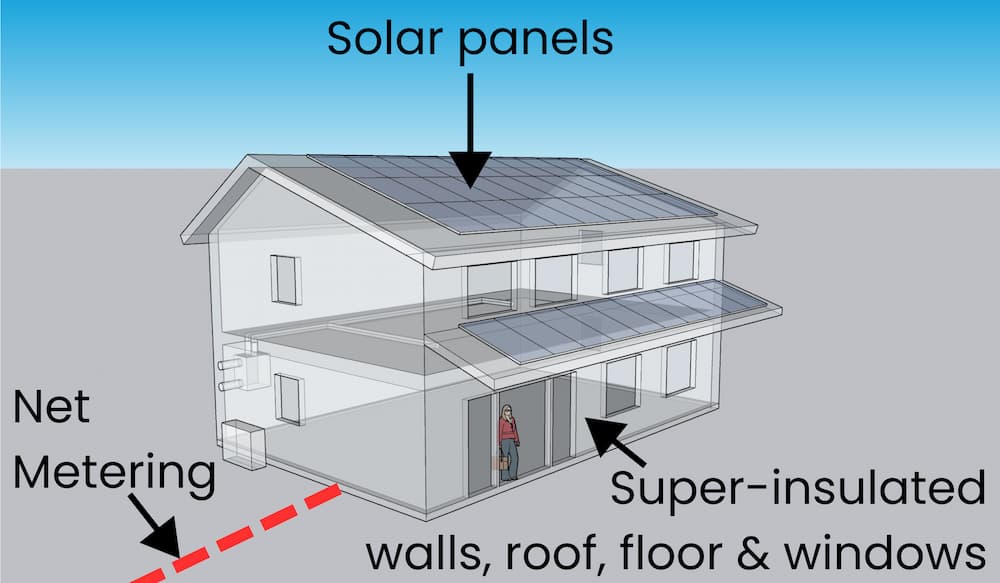
Here at Legend Homes we are excited to develop Net Zero middle housing, combining an appreciation of the earth's resources with an appreciation of a Bellingham ready to maintain affordability. We see the evolution of more housing types as a celebration of pedestrian & bicycle cultures, realizing a vision of a vibrant city with a home for everyone.
Still have questions? Shoot us an email! We’d be more than happy to answer any questions you have!
If you’re interested in learning more about our net zero energy homes or want to get started designing your very own net zero energy home, contact us today! We also offer pre-made net zero energy home plans!