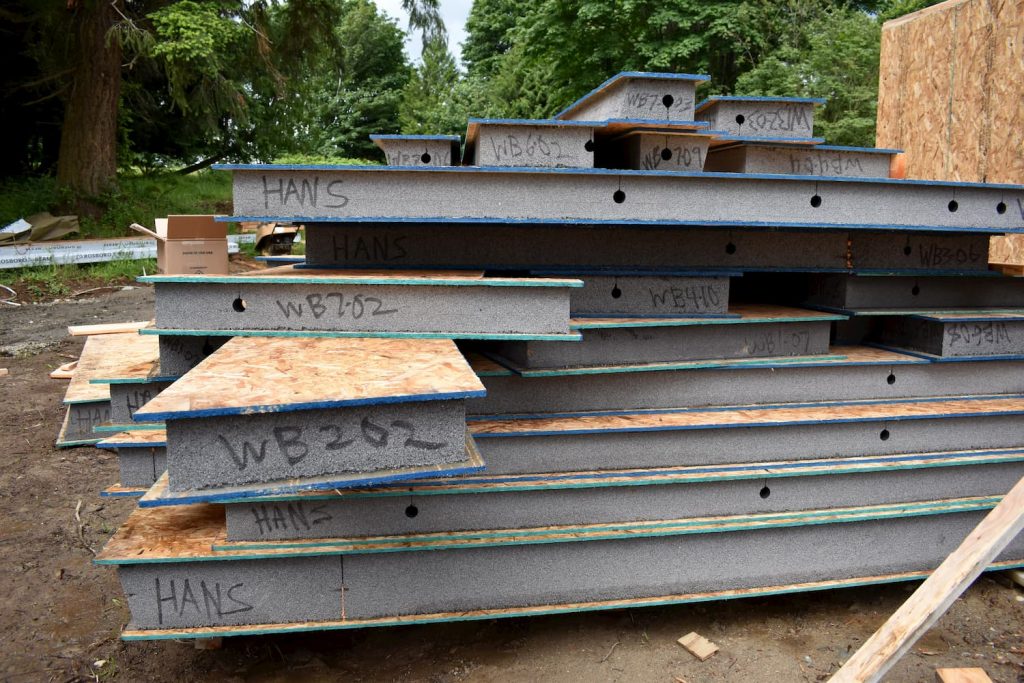
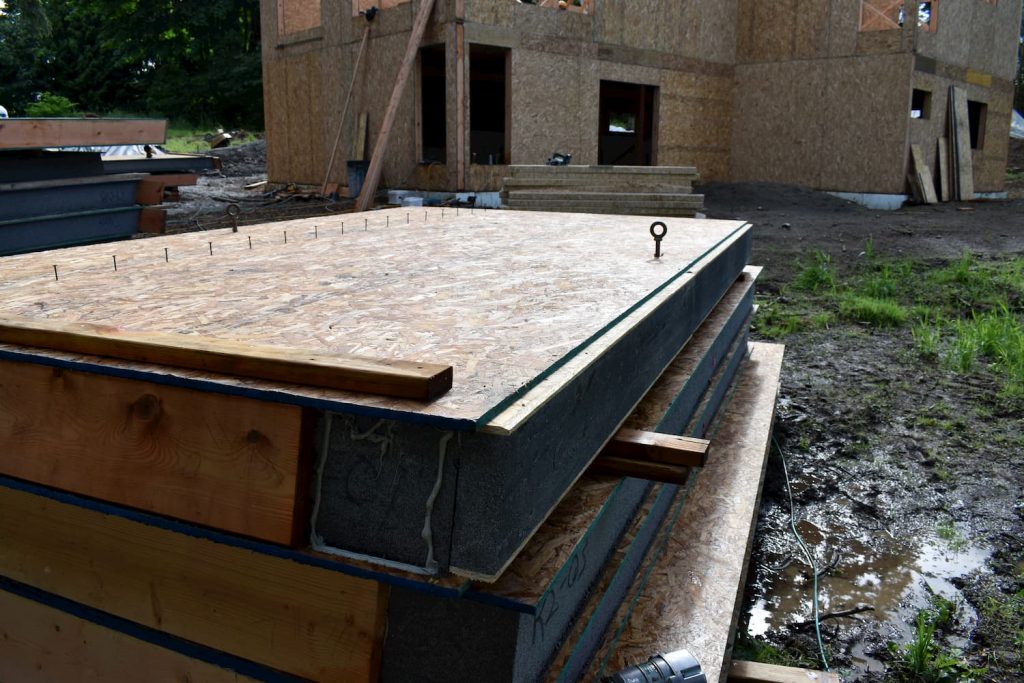
SIPs are wall, roof (and sometimes floor) panels. Fabricated from a slab of foam sandwiched between two plywood sheets. Actually, it’s not ply it’s OSB (oriented strand board).
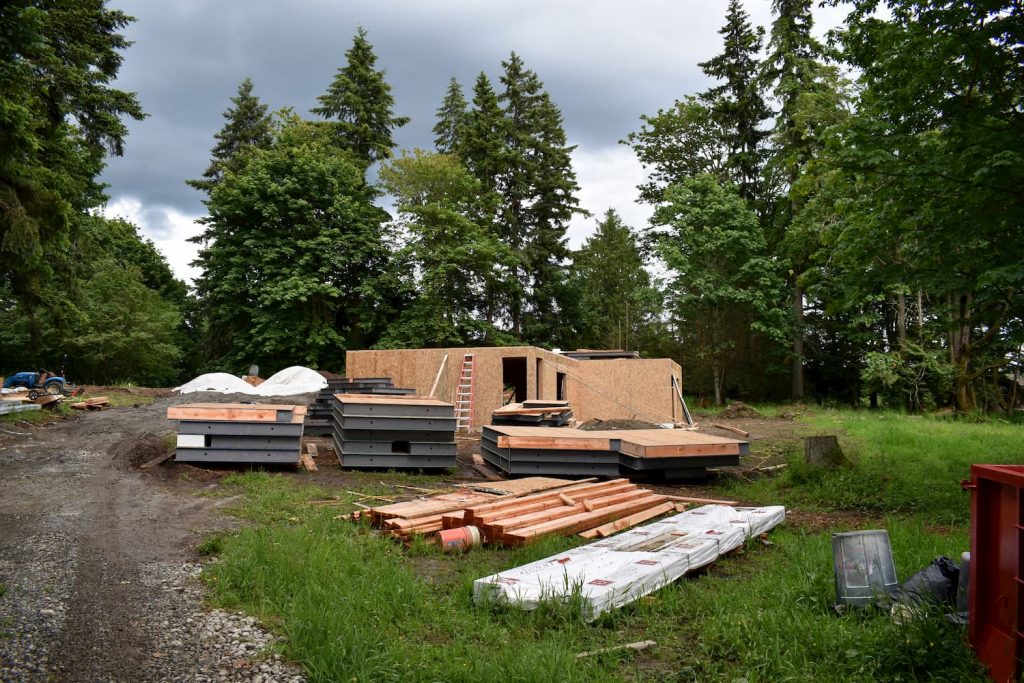
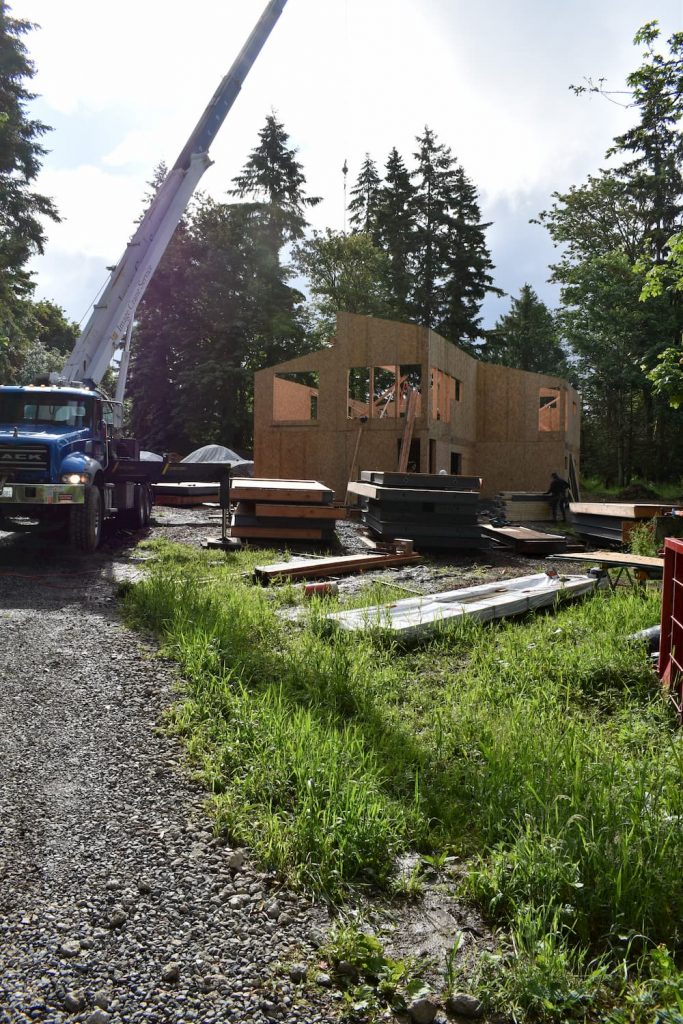
The sandwich-panels can be up to 24’x8’ and are made in the SIPs factory, in our case Premiere-SIPs in Puyallup. The doors and windows are cut-out in the factory, a stack of pre-fabricated house panels are loaded onto a trailer and arrives on-site where the SIPs are assembled… a bit like Legos.
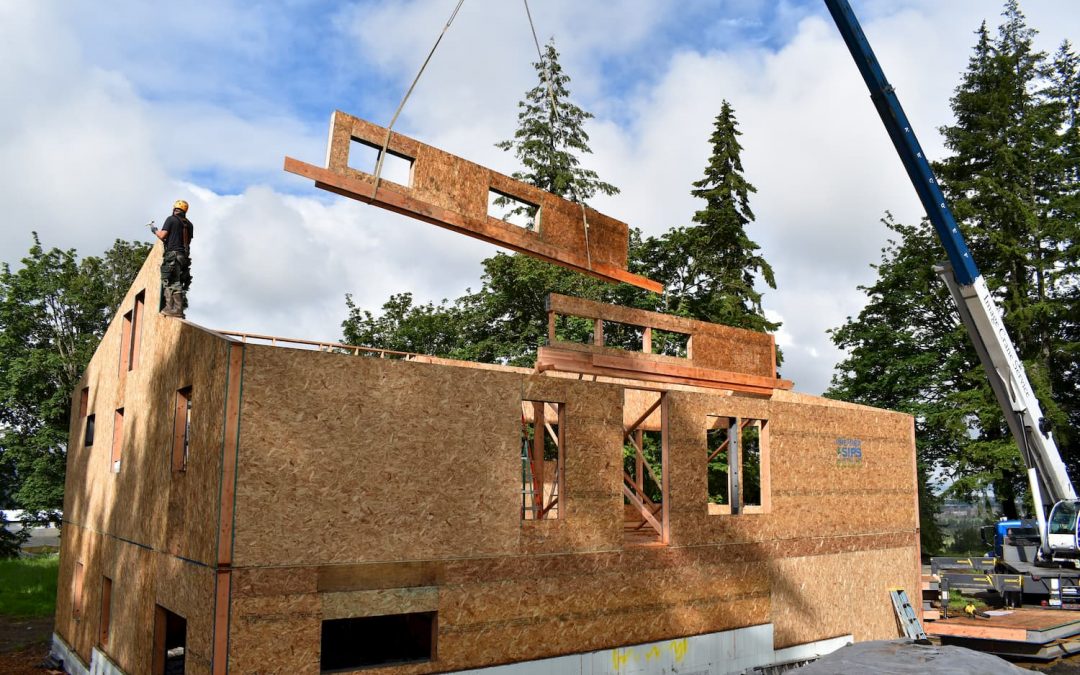
Because TC Legend Builds affordable Net Zero energy houses, we use our crew to assemble the wall panels, man-handling them into place, but a crane can be used for walls. We do use the crane to set to thicker, heavier roof panels.
Our goal with SIPs panels is to create a continuous foam box, surrounding the inside of the home. When you remember that there’s 4” foam under the concrete slab, the 6” foam walls and 10” foam roof trap all the heat inside the house.
The ‘S” in ‘SIP’ stands for structural and the panel-system carries the load of the house, floors and roof, and does not need the sticks of vertical lumber you see in the walls of a conventionally framed house.
How are SIP panels joined? We’ll use the walls as an example:
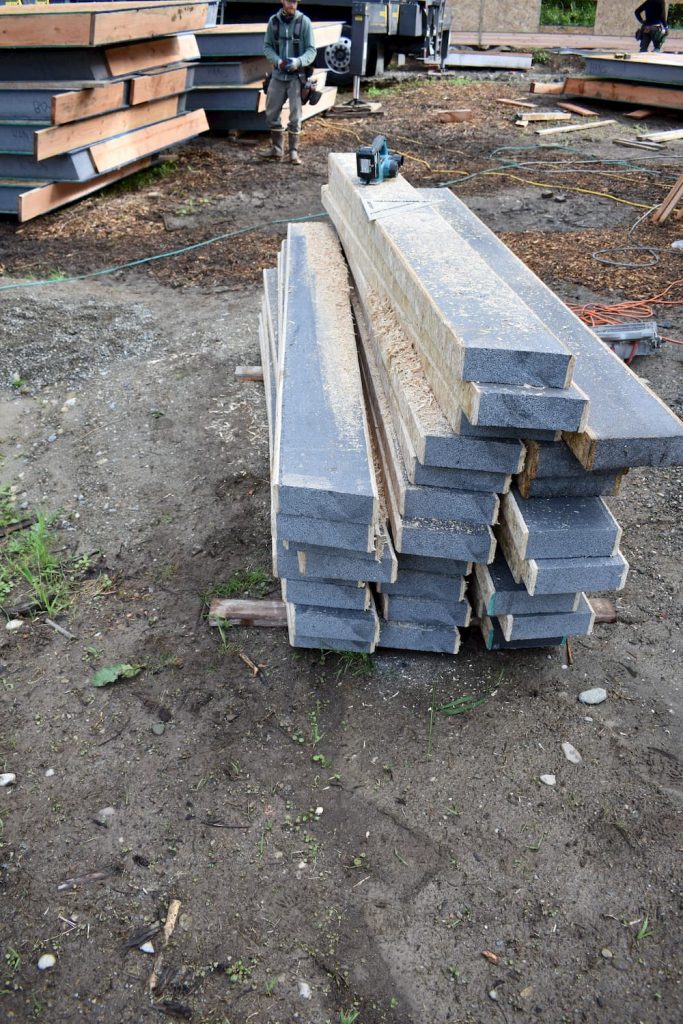
The SIPs panels typically have the interior foam held-back to form a 1.5” gap at the panel edges. Two panels are joined by setting a ‘spline’ into the recessed gap on one panel, then sliding the second panel over the spline, nailing the connecting spline in place through all four edges. Splines can be made of 2×6 lumber (L-spline), foam mini-SIPs (called S-splines), or an insulated TJI spline (called an I-spline).
Because a 2×6 lumber splines touches both the warm inside of the house wall, and the cold exterior of the house wall, they are said to cold-bridge. A cold-bridge creates a poorly insulated pathway for the warm inside energy to travel to the cold exterior. There a many cold-bridges in conventional framing and that’s why we don’t do it. We aim to minimize L-splines as they have an insulating value of R7.8, compared to R29 for our Neopor graphite foam 6.5” Premiere SIPs wall panels.
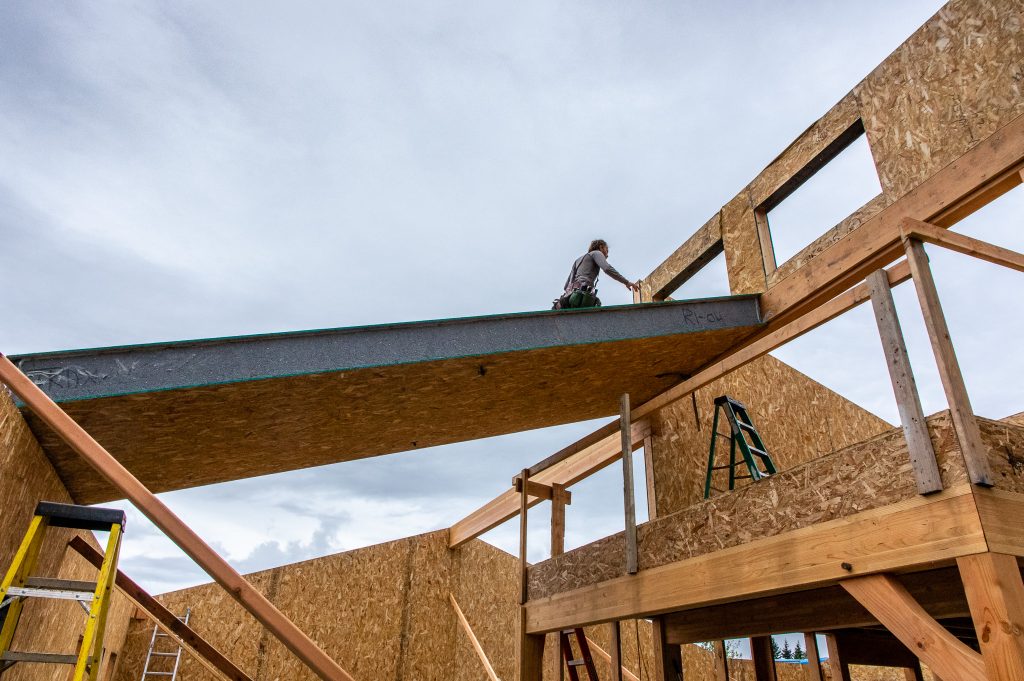
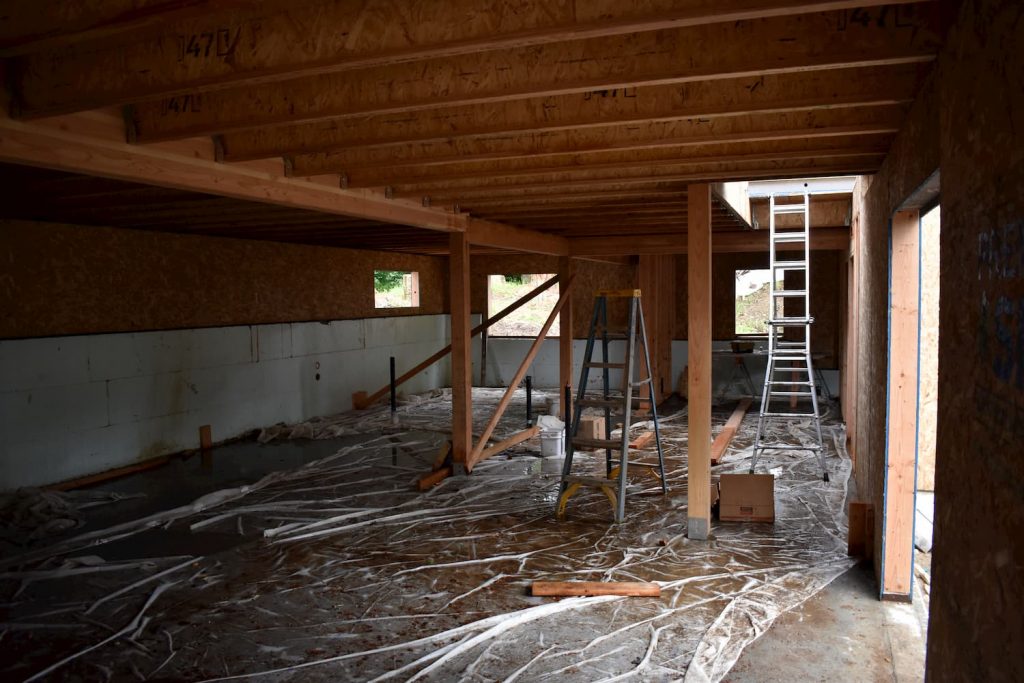
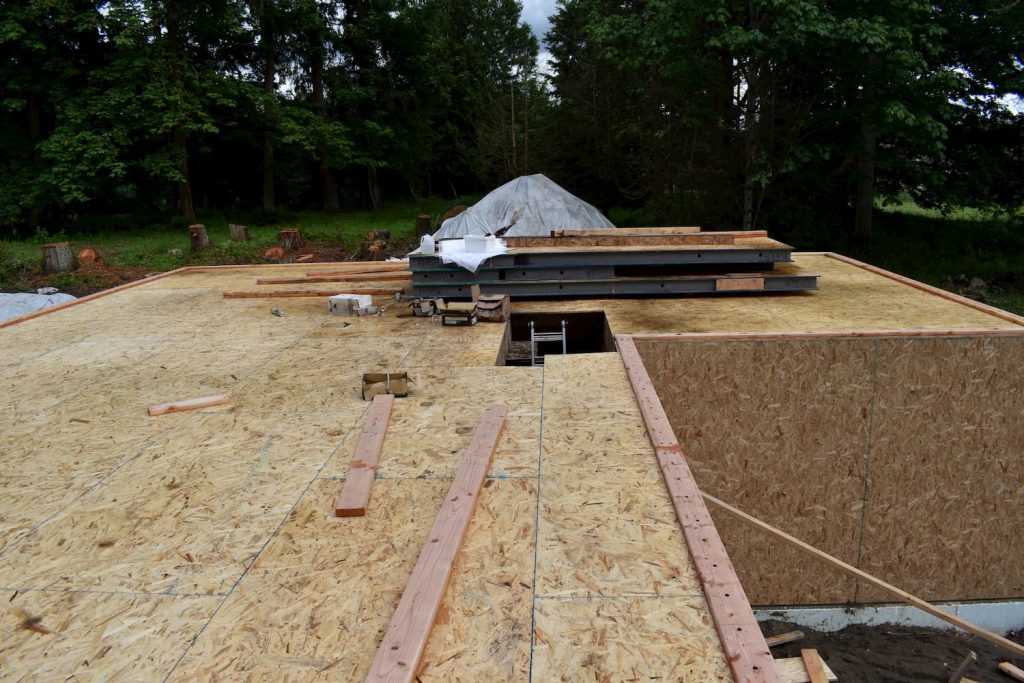
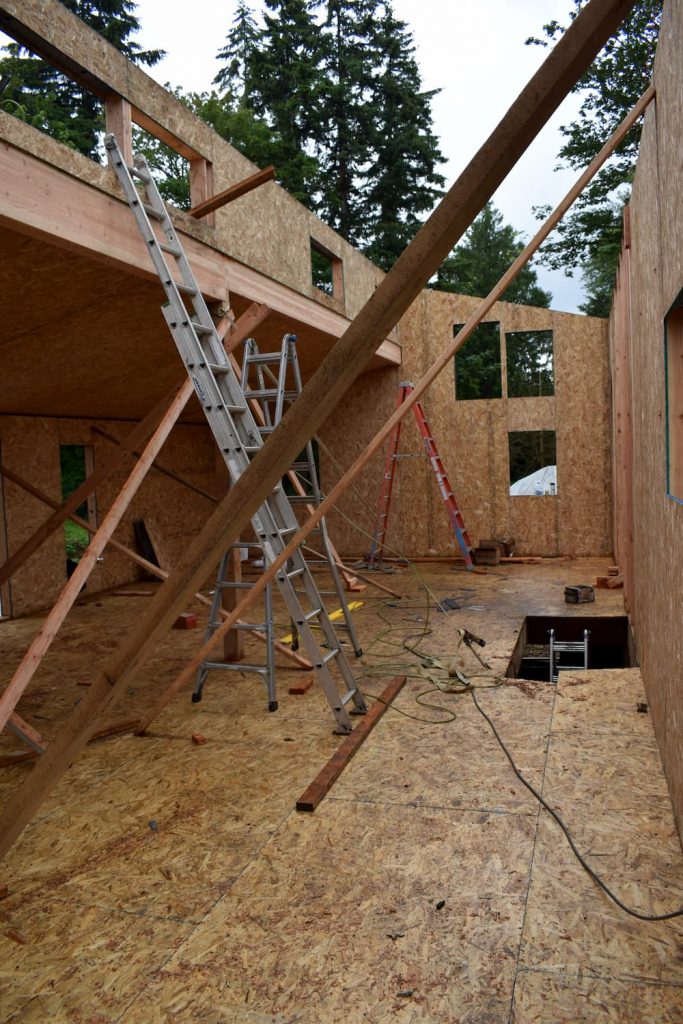
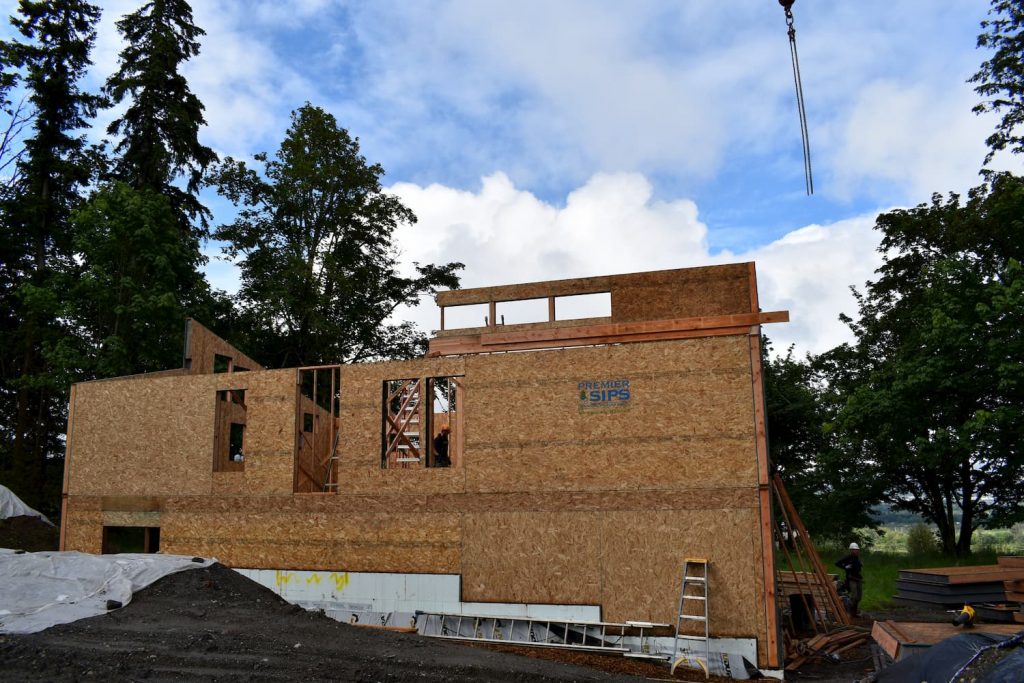
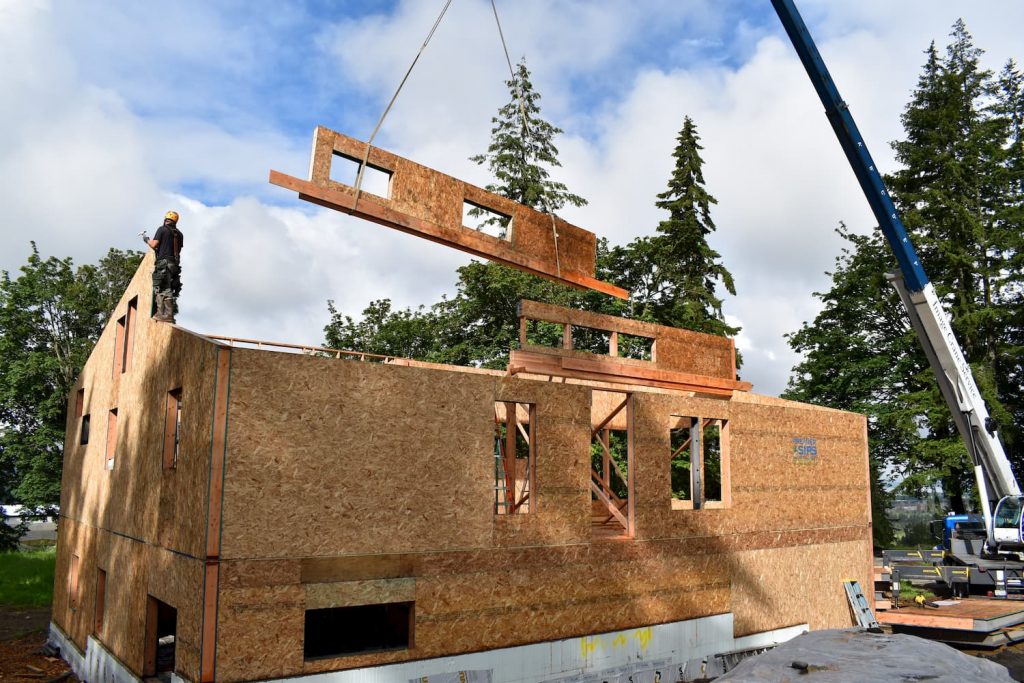
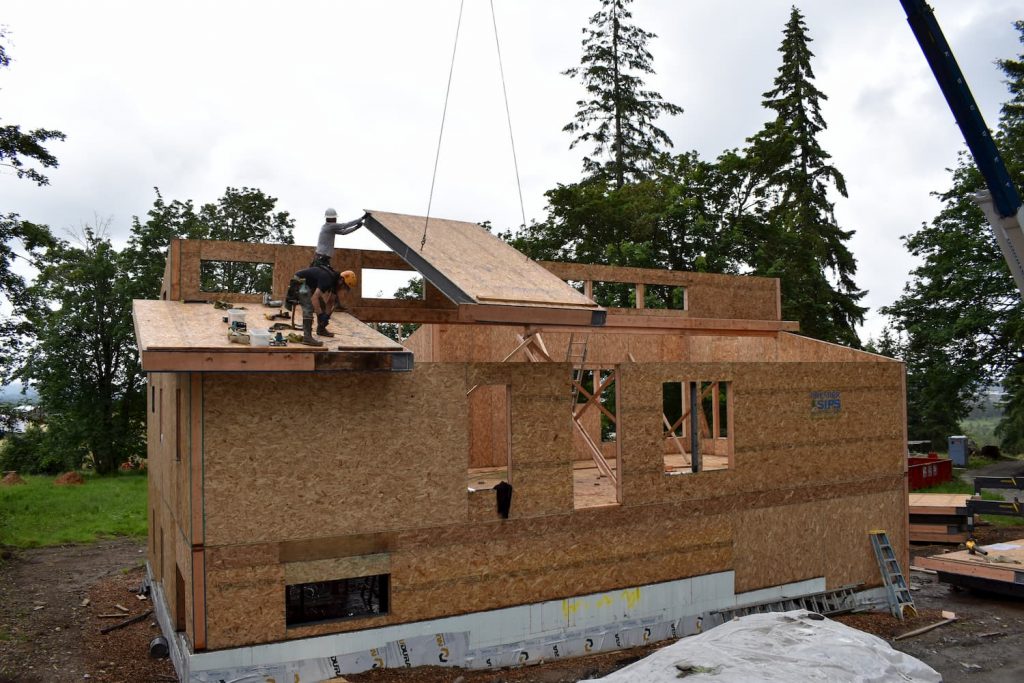
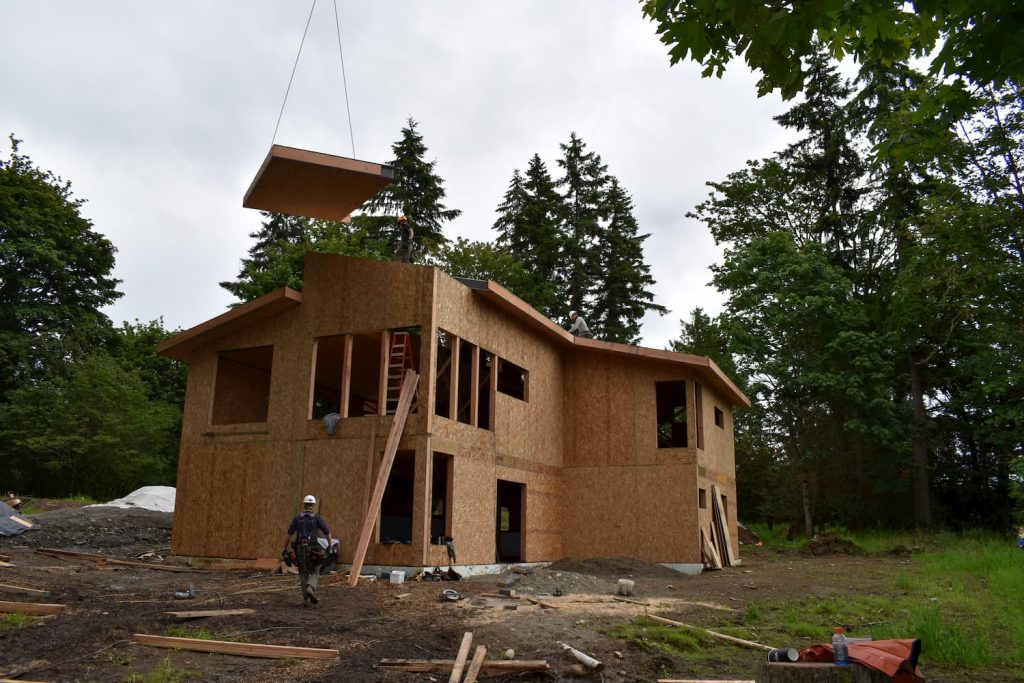
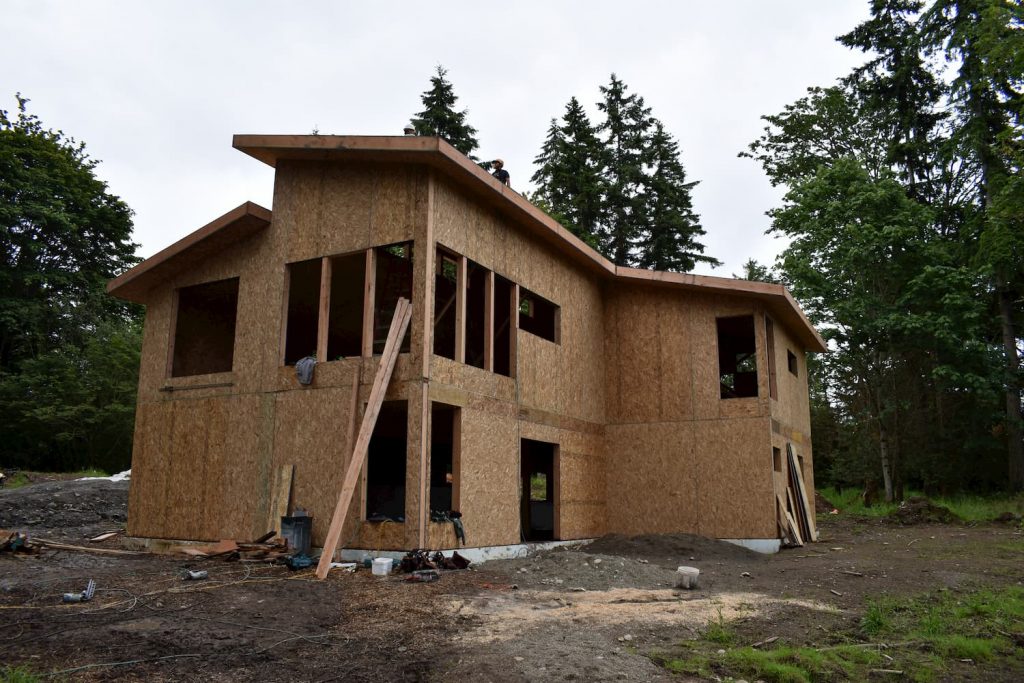
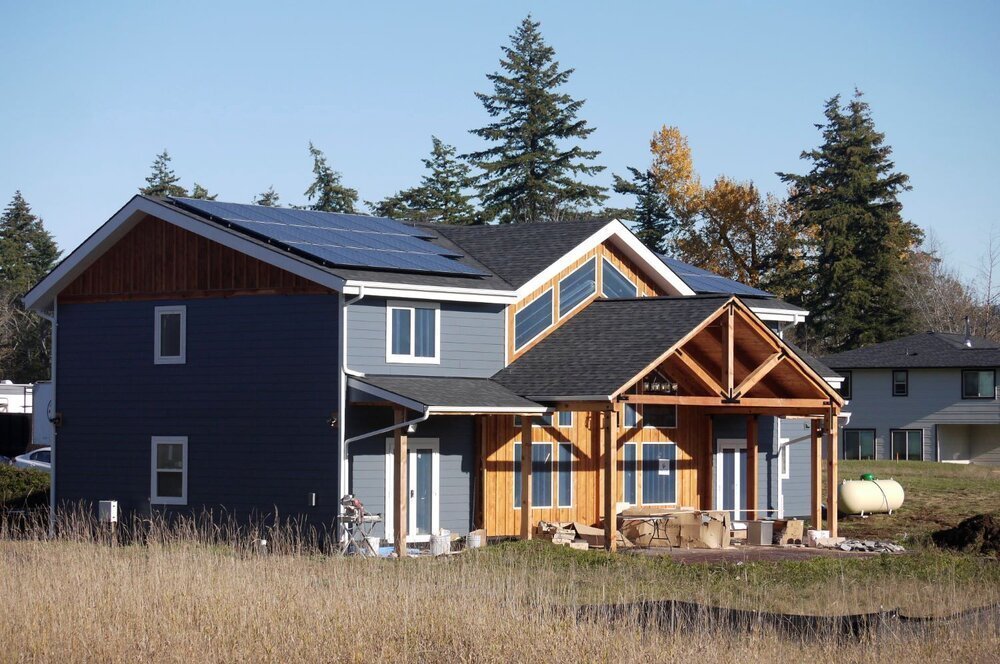
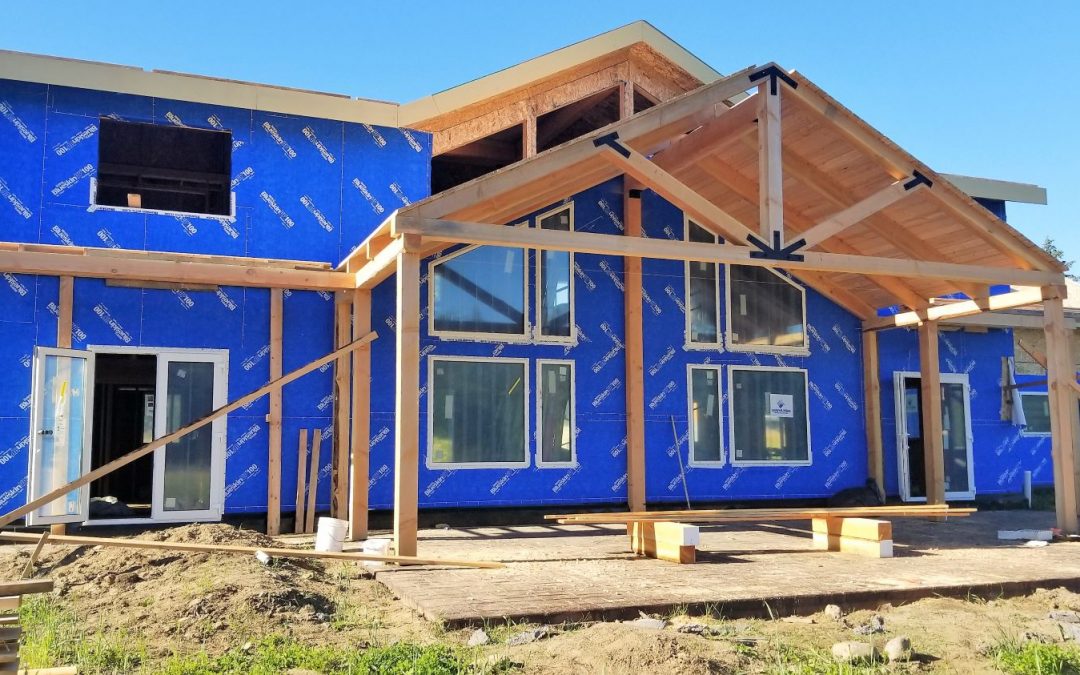
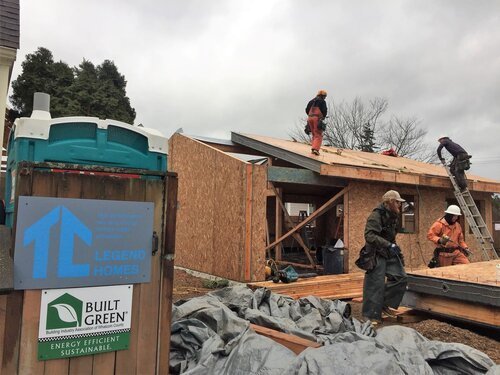
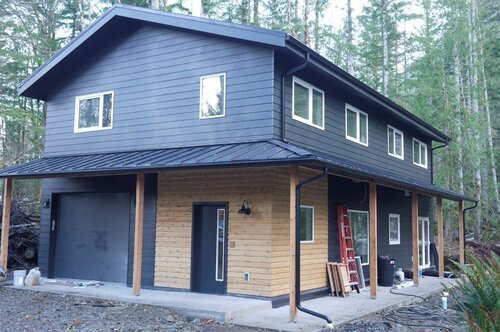
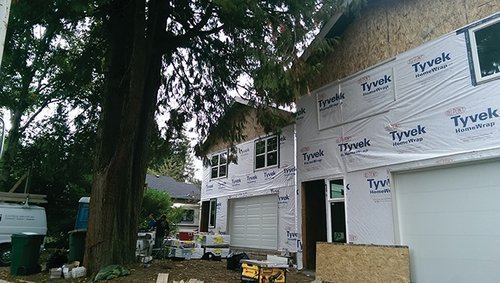
Last week the TC Legend Homes crew finished off the SIPs roof structure on the Lake Stevens house.
On average we take about (2) days to assemble the 1st floor SIP wall panels. We build the 2nd floor-level TJI and sheeting floor system over the succeeding (2) days. The upper level walls take a day or so, and then it’s roof-day!
On roof-day the crane arrives early, and the roof panels are rigged, swung up, and screwed in-place by Ted and Norm. The crew have pre-assembled the boundary supports, so we don’t use more crane time and belch more diesel than necessary. The boundary support is a continuous 2×10 that seats into the 1.5” perimeter recess & connects together the outside edge of the roof panels.
SIPs are very fast to assemble and incur almost no waste material onsite because everything arrives pre-cut. Most excess off-cut foam is recycled back into the process during factory fabrication and the Premiere software nests the required panel shapes for maximum efficiency, making Premiere more streamlined, more profitable and more environmentally responsible.
Air sealing is very, very important for energy efficiency.
Imagine a fast, cold wind blowing over the building and all the warm air streaming out through the construction cracks. The Lake Stevens house is modeled to need a maximum of 12,500Btu/ hour to heat in midwinter, if we air-sealed the envelope to 0.6 air-changes per hour. (Note: (1) air-change-per hour assumes the entire volume of the house has the air replaced once within (1) hour).
If we air-sealed the Lake Stevens house to 5.0 air changes per hour, code minimum, we’d need 19,000Btu/h of heating for midwinter! So you can see that air sealing to reduce the air-changes per hour can give over 35% reduction in heating load.
SIPs are a pre-sealed sandwich, and compared to typical construction there are far fewer construction-joints in a SIPs building due to the large SIPs panel size. The standard SIPs assembly process includes installing beads of specialist mastic to air-seal and adhere the panels to each-other. SIPs have a measurable dollar advantage with that high level of pre-sealing and easy panel-to-panel air sealing. Meaning you can buy and run a smaller heat pump. And we haven’t yet examined the standard R29 insulation in the equivalent 2×6 wall!
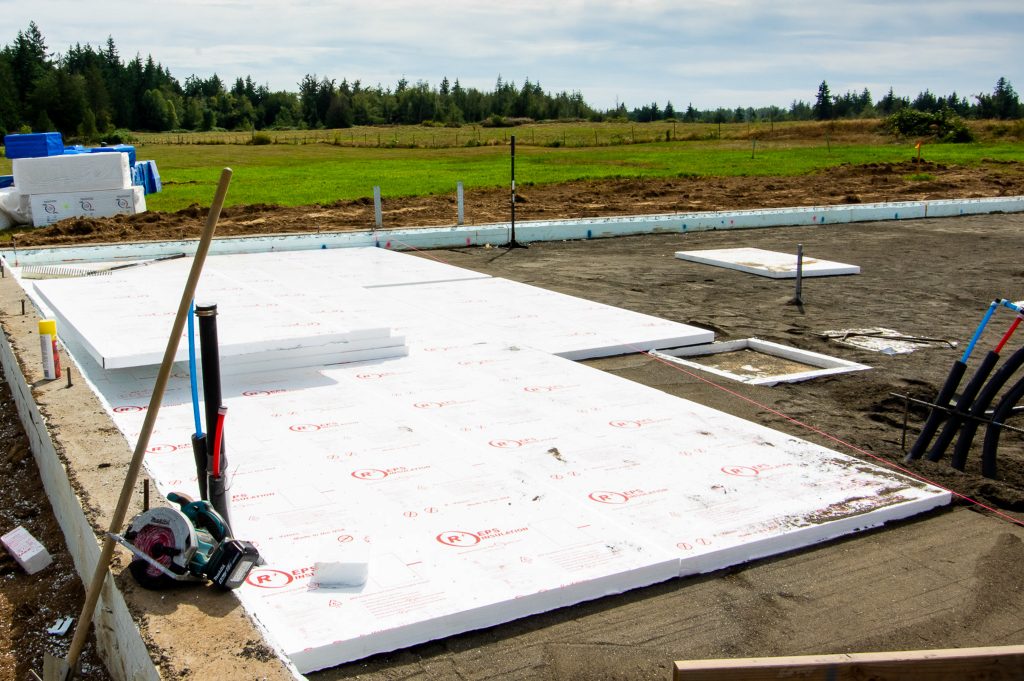
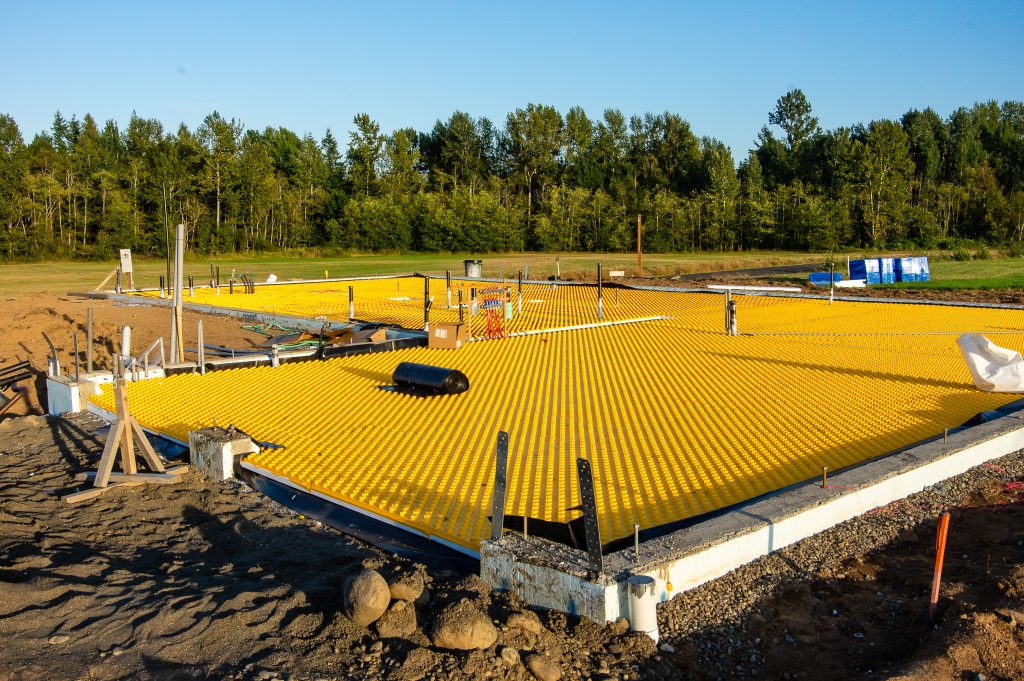
When we pour a slab on grade we are basically pouring concrete directly onto the earth. Sure, there is a 4” layer of foam under the concrete so we don’t lose our heat, and yes, there is 12” of sand under the foam so the foam sits perfectly flat and the plumber can easily locate drainpipes in the sand… but under that sand is the compacted native earth.
No crawl space, rats, trash or mold, just a crisp concrete slab sitting on the earth, insulated so the slab holds in heat (or cold), and keeps the temperature inside the house consistently stable.
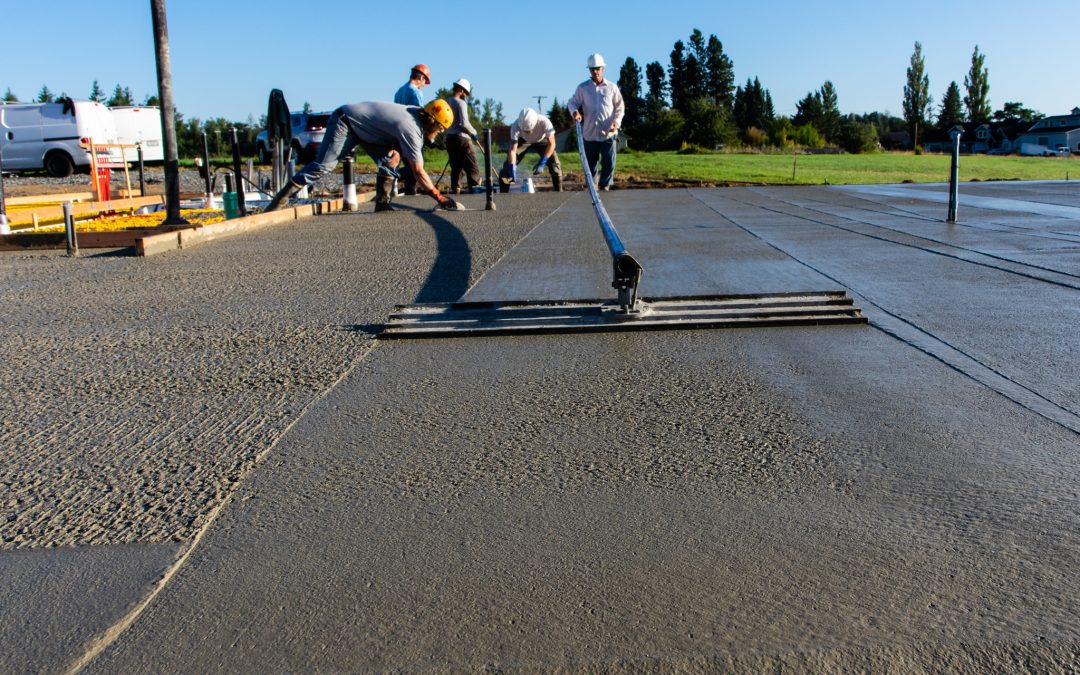
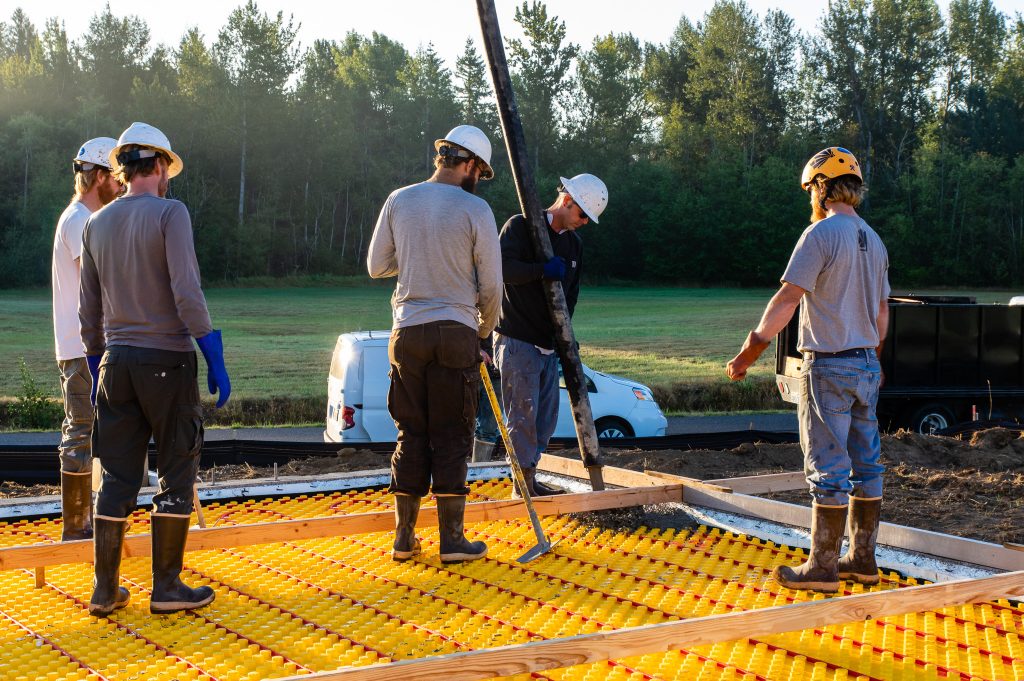
Slab-day is stressful, because many of the affordable Net-Zero houses from TC Legend use the slab-on-grade as the finished-floor.
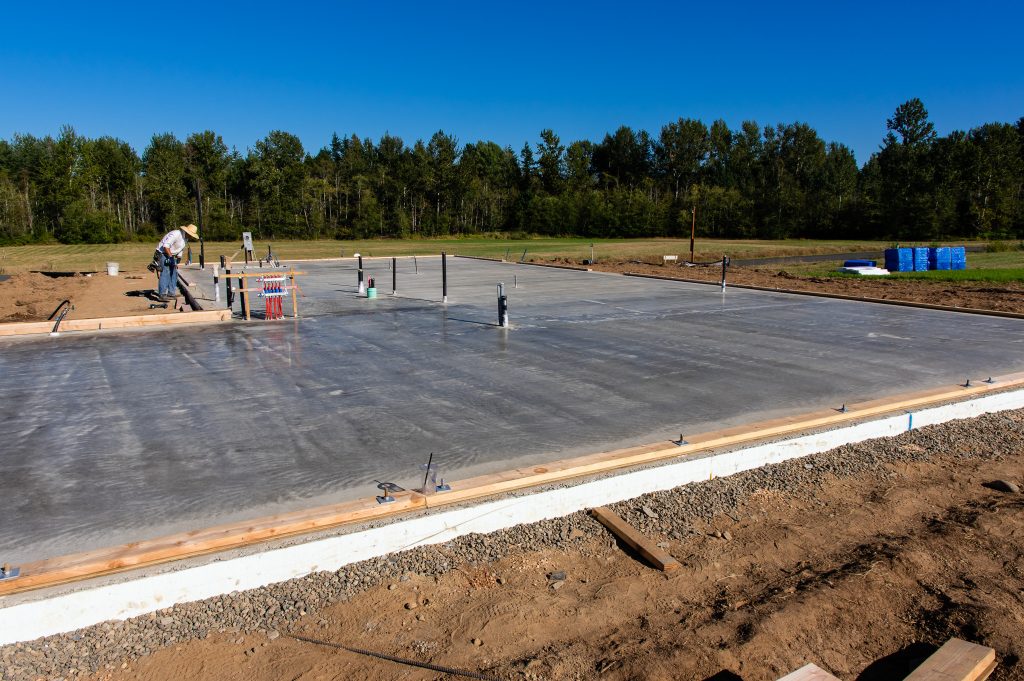
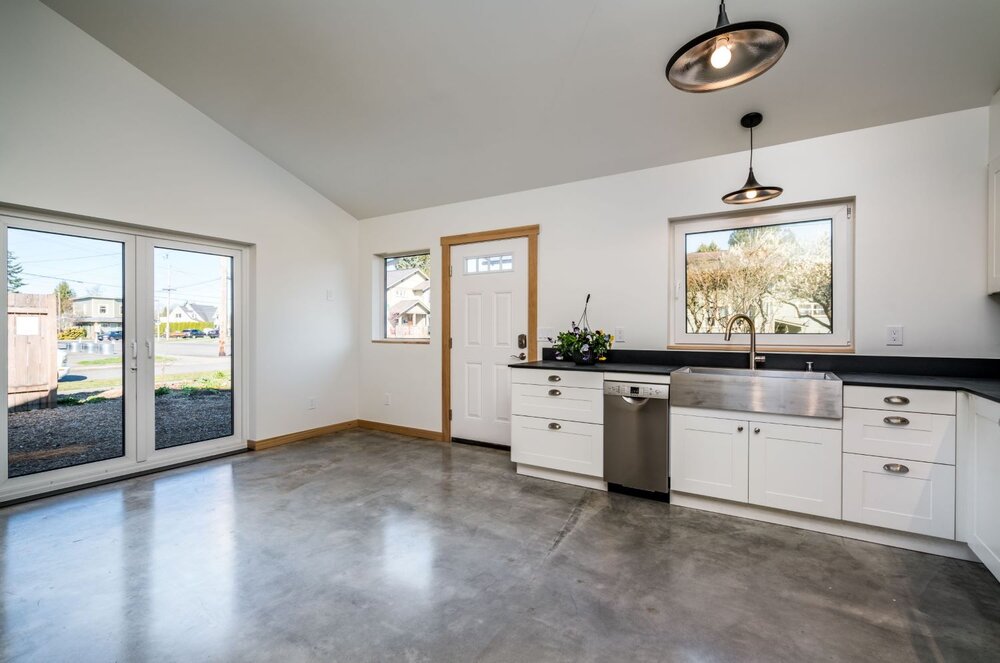
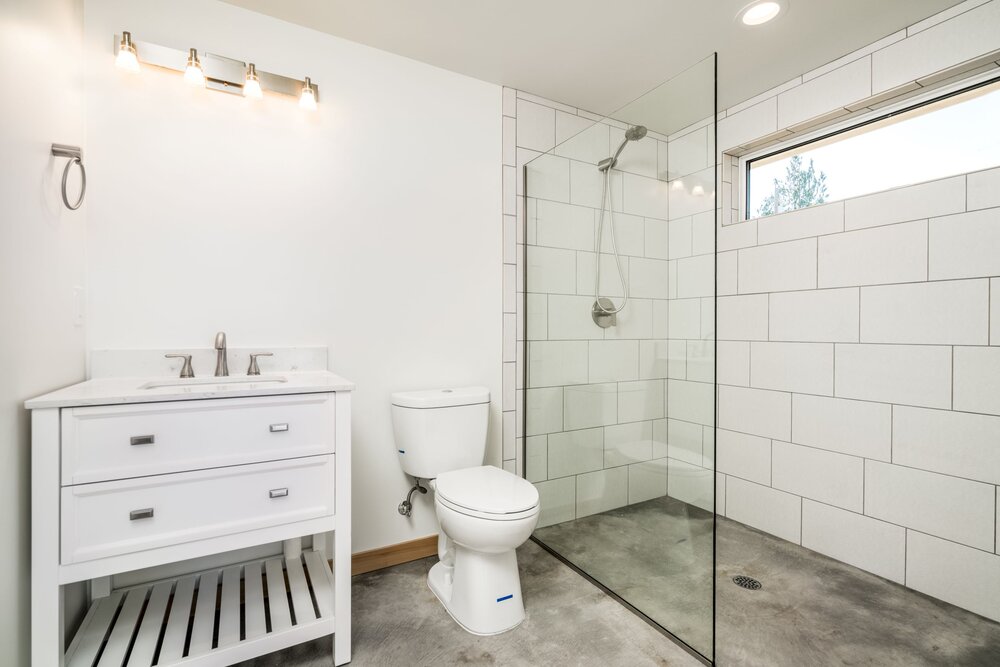
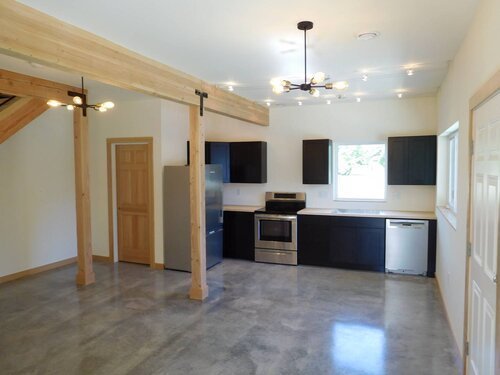
Concrete slab as a finished floor provides a cost-effective, durable, aesthetically modern floor. However, the concrete needs to be finished perfectly flat on “Slab Day.”
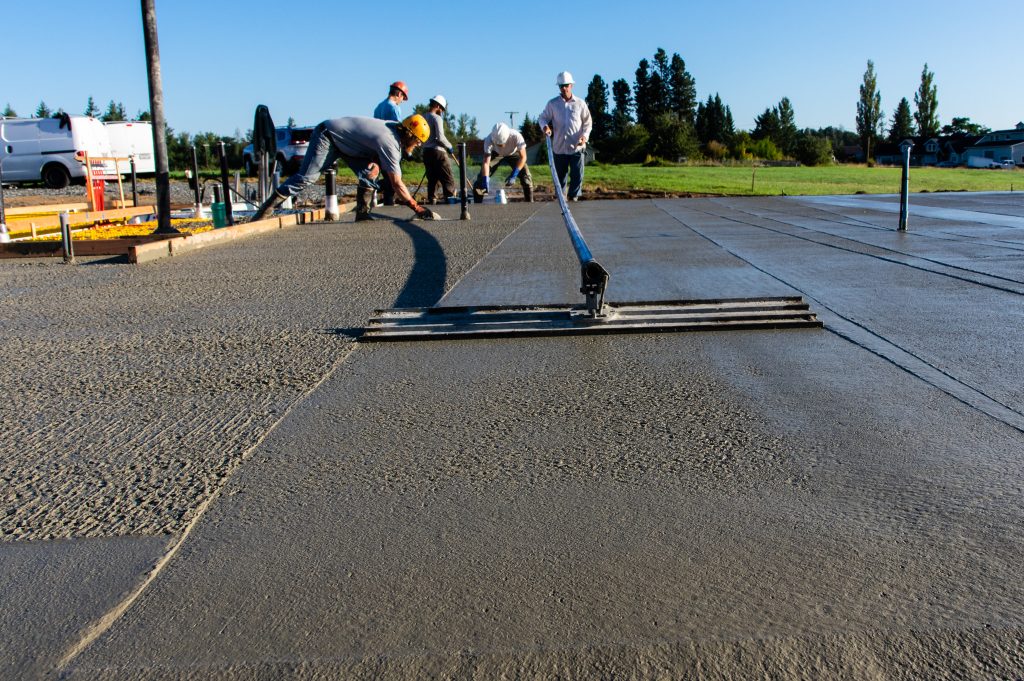
Last week at the Lake Stevens house, the second concrete truck was late and the guys had to scramble to pour and screed the last truck-load before a permanent seam became inevitable!
Disaster was fortunately averted, the 1,500 square foot (sf) floor had the seam massaged-out, was troweled flat, covered in plastic and will be scrubbed and sealed in a few months before the trim goes up.
There are other finish options for concrete floors; they can be ground down, acid etched, and stain can be added to the concrete in the yard.
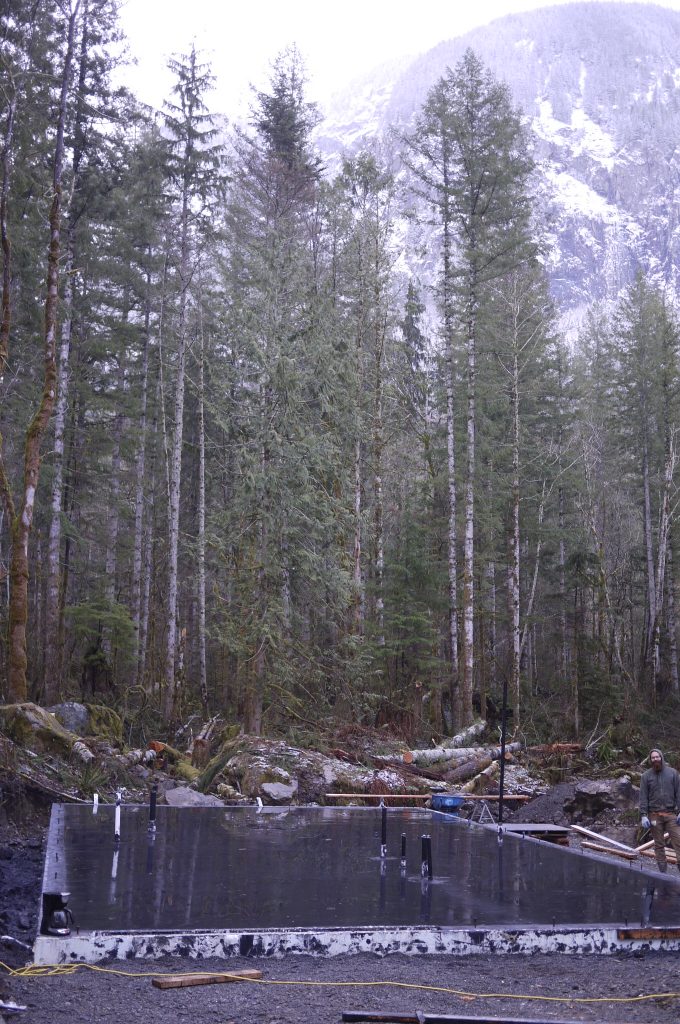
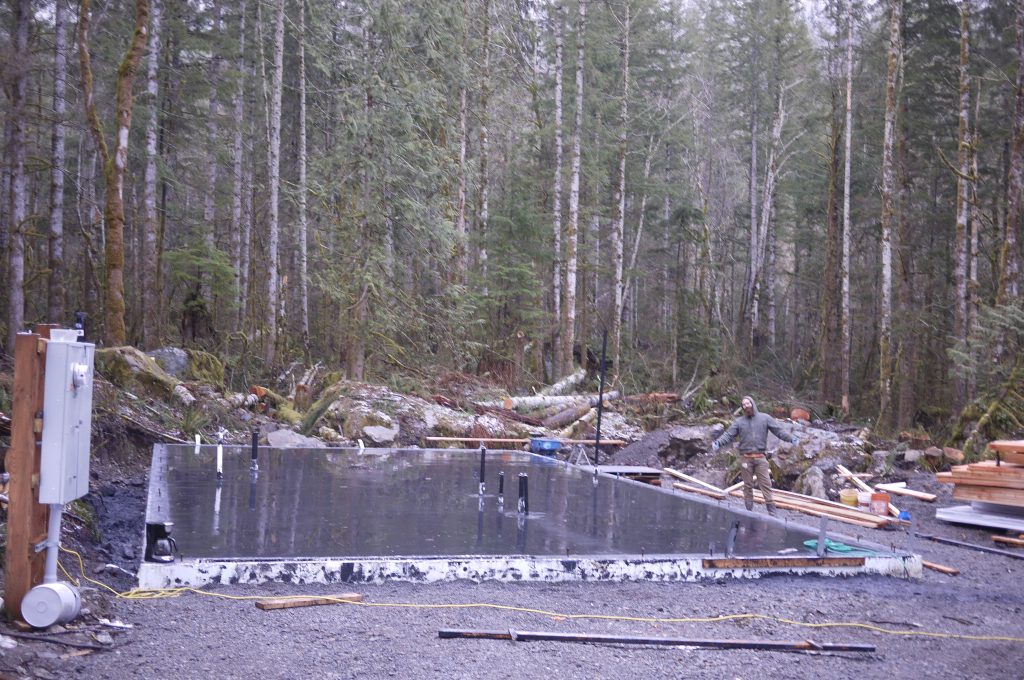
The following photos are gathered from a couple other already-built jobs. Dan was too busy at Lake Stevens last week, shoveling, troweling and de-stressing the crew to run a camera.
The black slab under the mountain was poured using black dye within the concrete.
The yellow Legos are a layout grid for in-floor radiant hydronic heating, which until recently was one common heating option deployed within our Net-Zero homes (more on heating systems soon).
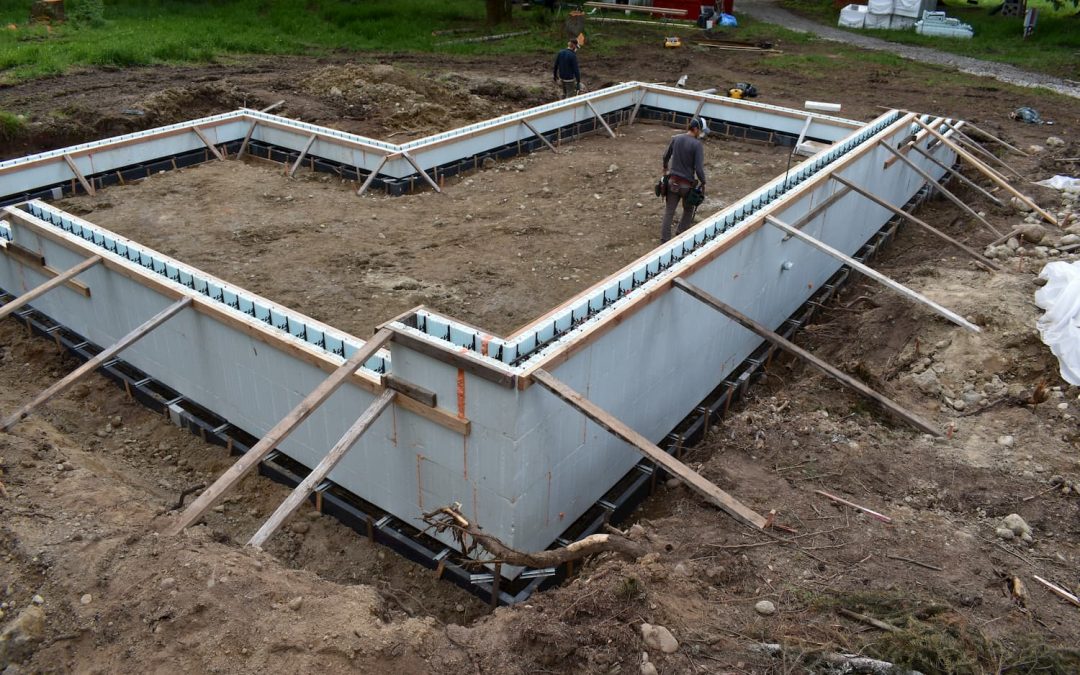
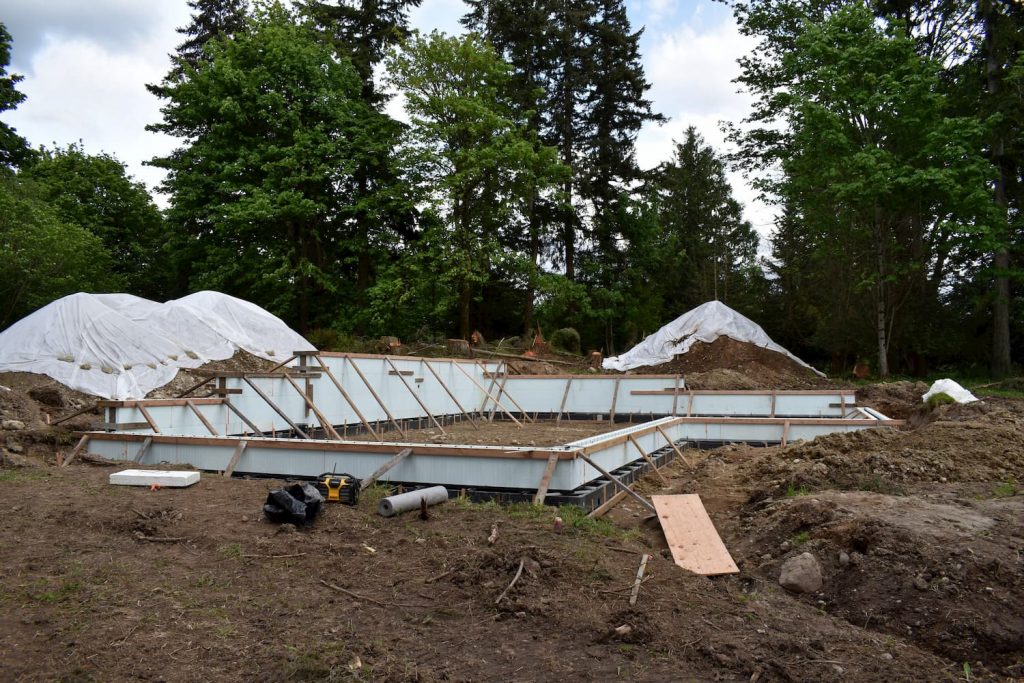
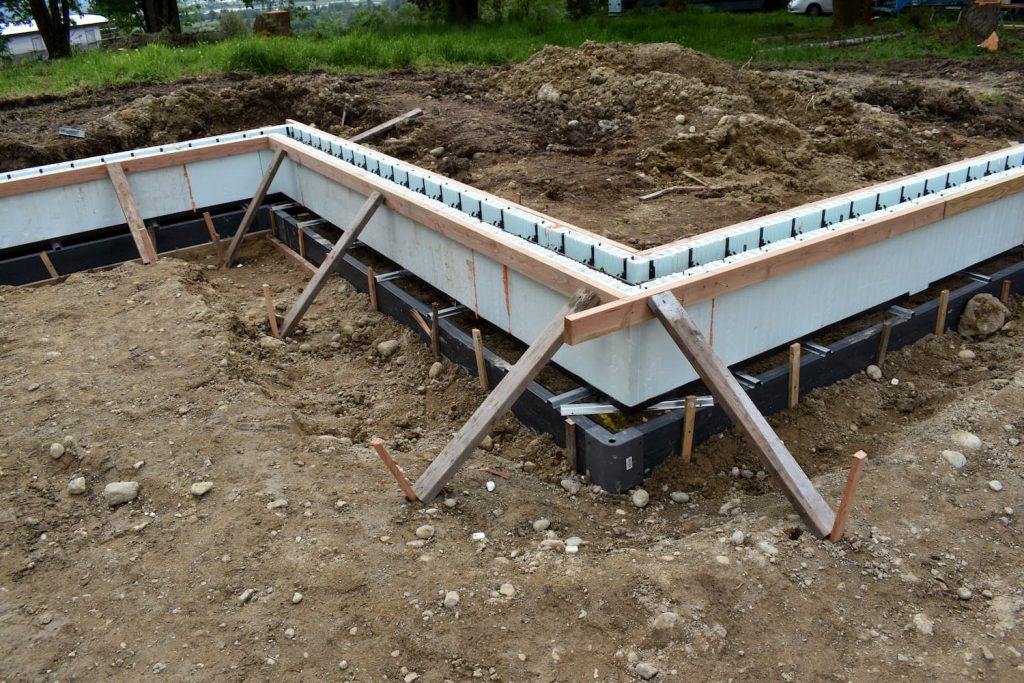
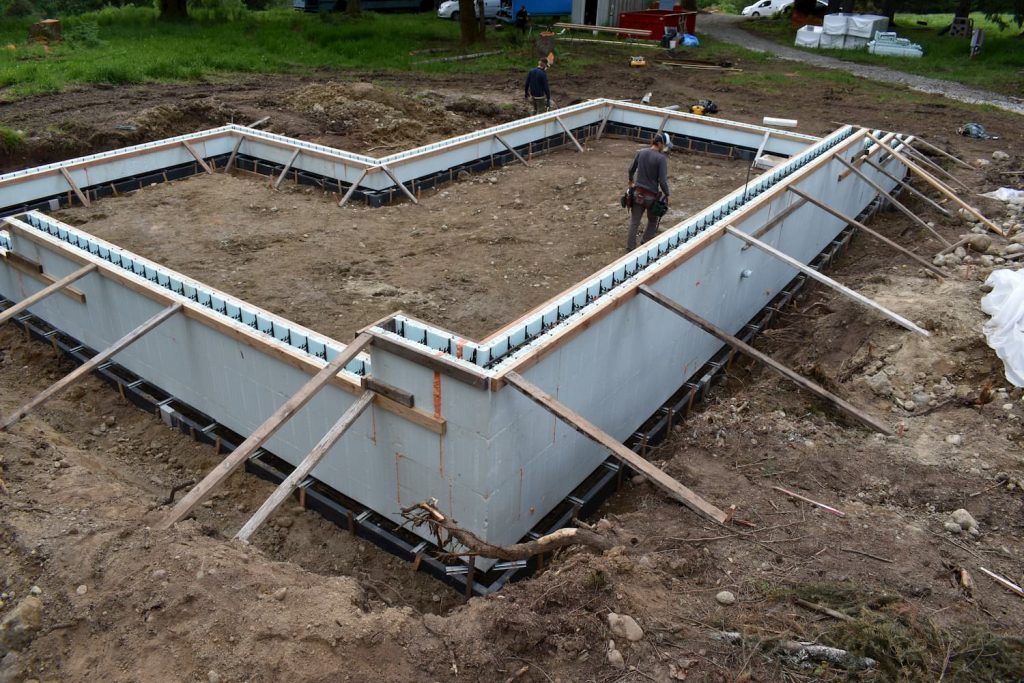
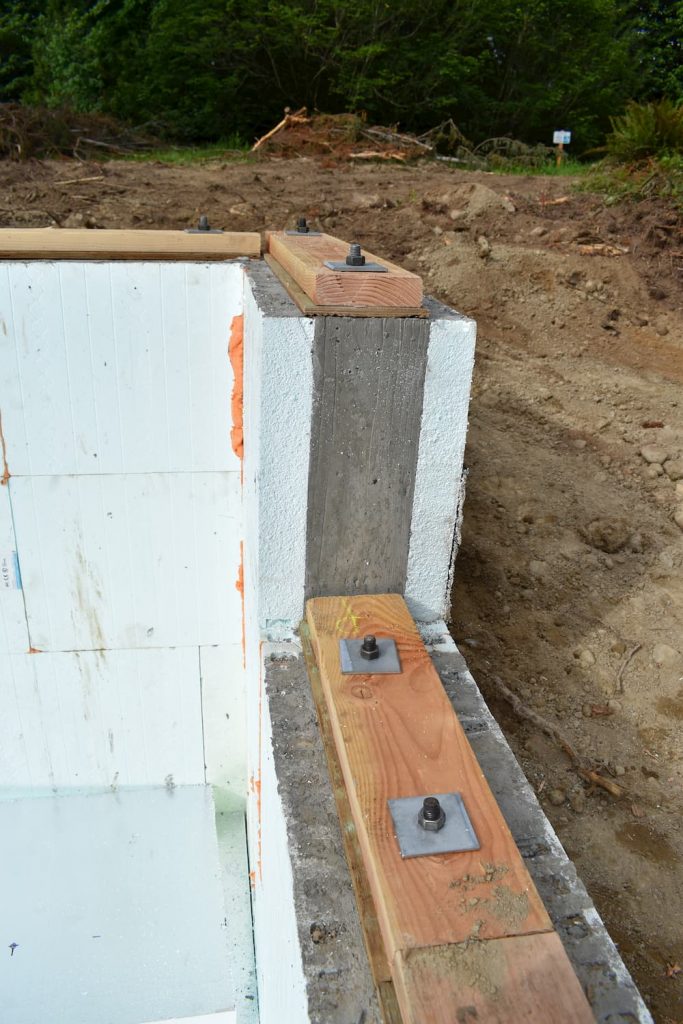
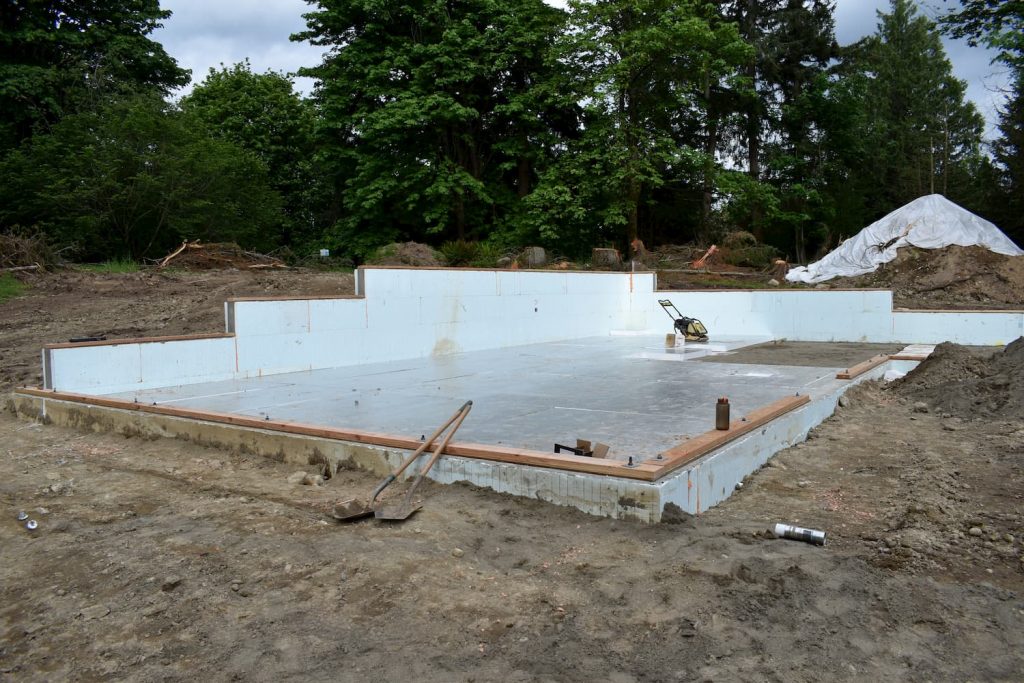
The TC Legend Homes fellas put up the Lake Stevens house’s insulated concrete form (ICF) walls in the rain last week over the course of just (2) days! Dan said it went well since the soil had a good consistency to seat the Form-a-Drain footing, and the blocks went up fast, as per usual, since everyone likes stacking up Lego blocks!
A Net-Zero house is insulated on all (6) sides, and TC Legend builds with structural insulated panels (SIPs), so we have R-29 SIPs walls all around, R-49 SIPs roof above, and 4” R-20 foam under the slab-on-grade.
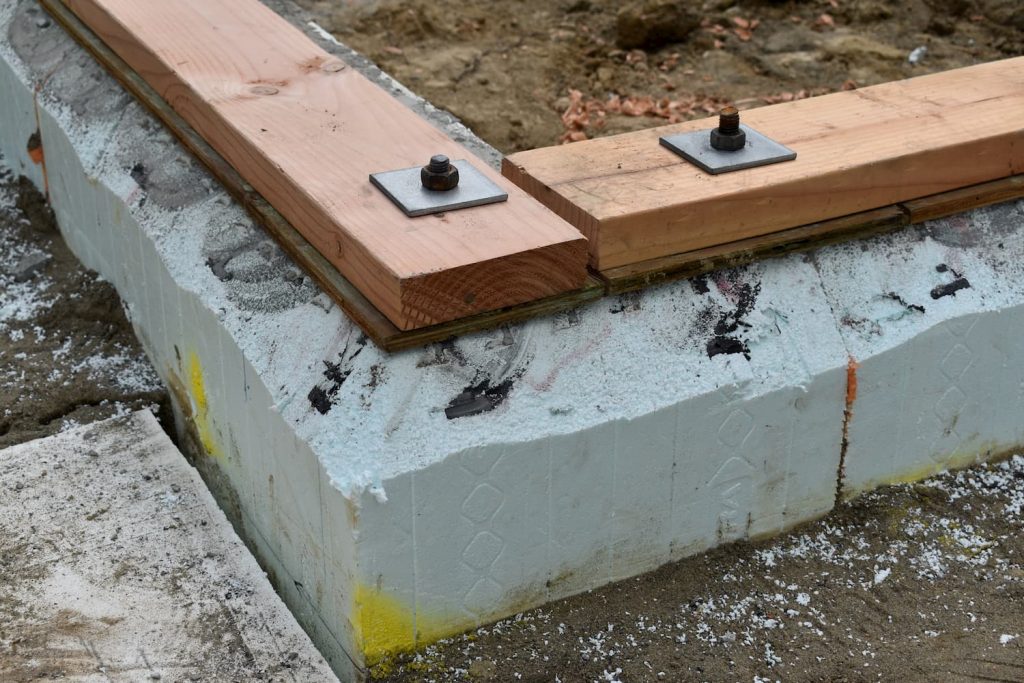
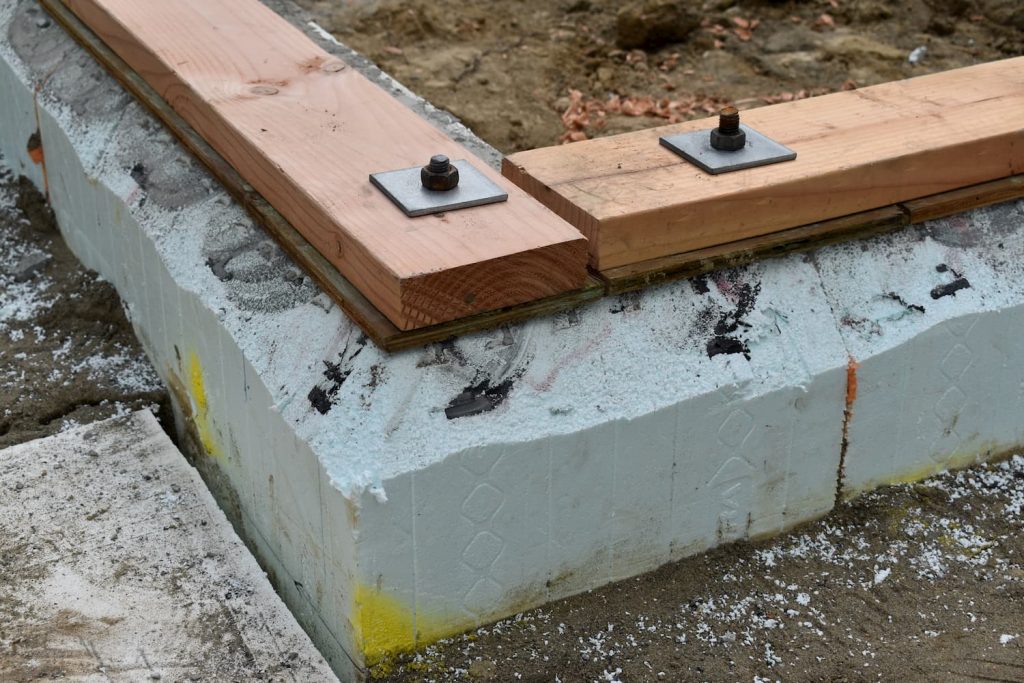
The edge of the slab also needs insulation, otherwise there would be a weak spot and heat would leak out through the slab perimeter, into the stem-walls (which are exposed to the weather).
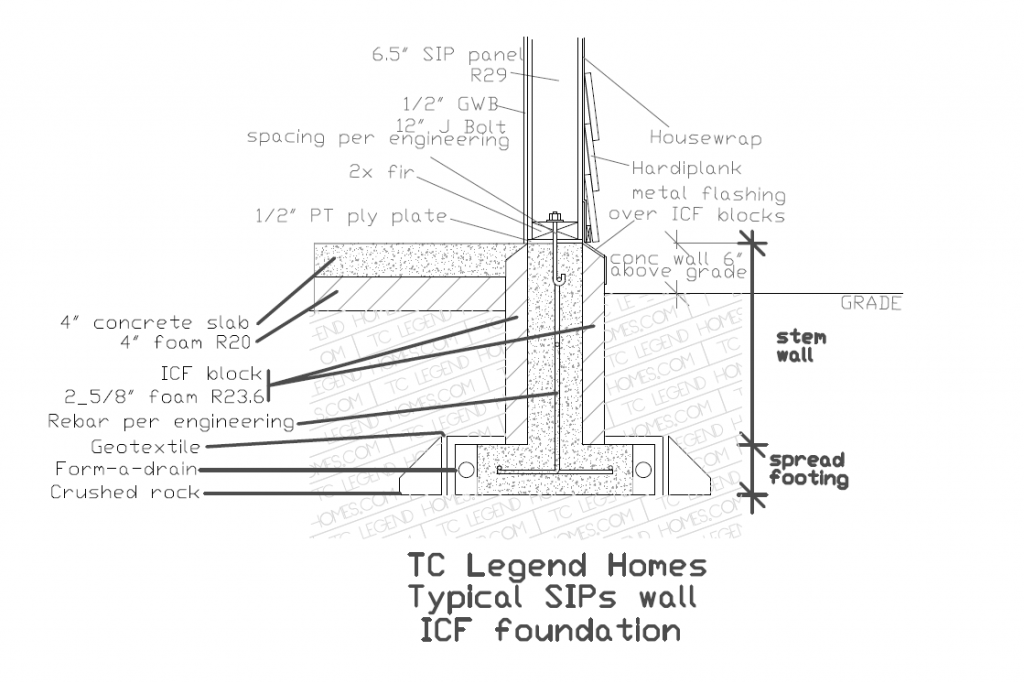
We solve this problem by pouring the stem-walls into R-24 ICF forms which complete the insulted shell of this affordable Net-Zero home.
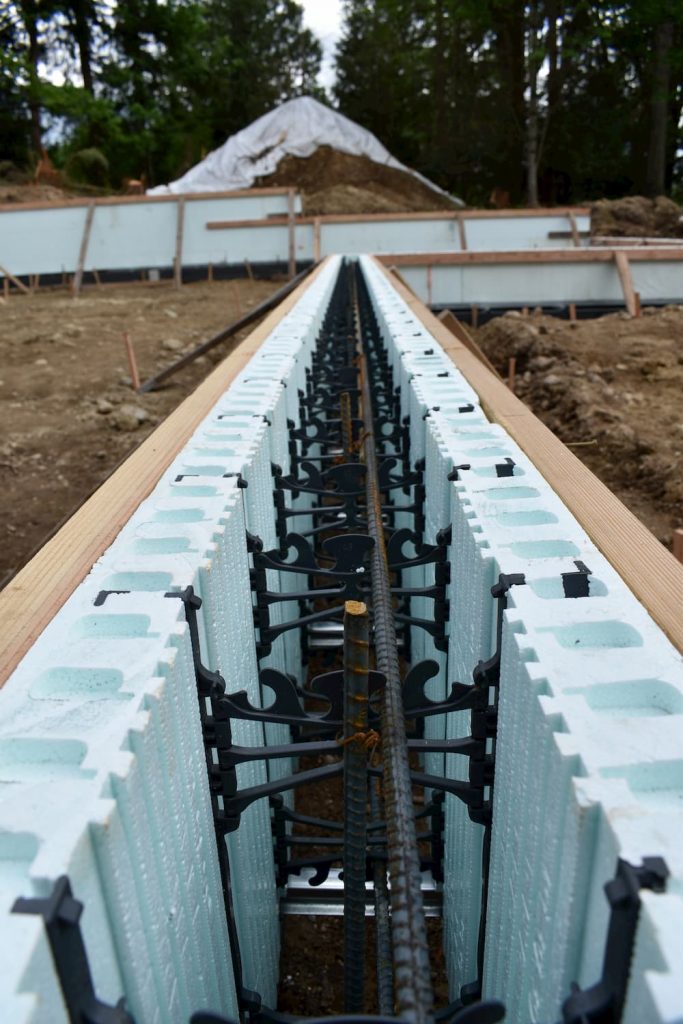
Concrete has been poured into foam wall-forms since the ‘80s. The hollow blocks go together like Legos with the required re-bar clipped inside, and once full of concrete, the Styrofoam block remains in place performing the job of insulation, and containing concrete while wet. The process is fast and clean, and has lower labor costs compared to traditional concrete forming.
We use NuDura R23.8 ICF blocks to form the stem walls, and retaining walls when we need them. The NuDura blocks are great since they concertina-down to transport. ICF blocks are available in many thicknesses with many variants for different construction requirements. We use 6” walls and usually only order inside-corners, outside-corners and 8’ straight blocks. The NuDura blocks have hard plastic structural strips that accept screws for siding and drywall.
The blocks sit atop the hat-channel that spans the footing form. At Lake Stevens we used Form-a-Drain footing form which, like the ICF’s does not need a form-board to be stripped-down after concrete is poured. The Form-a-Drain replaces 8” footer boards, is hollow, and drains water away from the foundation foot.
The Lake Stevens house has a 4’ stepped retaining wall up-slope and NuDura supply a very, very sticky vapor barrier to waterproof the stem-wall. TC Legend Homes has a metal cap/ cladding system system that wraps the exterior ICF foam from the sill plate downwards below-grade with roofing metal, leaving no visually, or thermally exposed concrete.
ICF’s are great for us! They perform two functions: (1) insulation, and (2) concrete form, they are a smart solution for our thriving Net-Zero, and increasingly Net-Positive SIPs housing in Washington state!
We found out we won the Residential Energy Services Network (RESNET) “Cross Border Challenge” award for Net Zero American Home Builder. This was for having a HERS Index Score of negative 25 on our Bellingham Affordable Net-Positive Home! Big thanks to Elizabeth Coe, our go-to for third-party certification!
We fielded our first-ever Ski to Sea team!
Sustainable Connections featured a recent detached accessory dwelling unit, which they dubbed “Gentle Density,” in the NW Green Home Tour.
We updated our Portfolio with some recent projects. Links to each of them are here:
The Department of Energy just recently let us know we won another Housing Innovation Award in the Custom for Buyer Category for the Whatcom County Net Positive (above).
That’s it for now – enjoy the rest of your Summer, and we’ll touch base again soon!
Here at TC Legend Homes, we are excited to ring in the New Year! We kept busy in 2018, but we were not as active as we would have liked in keeping our “fans” updated on our recent projects. So, while we’re committing ourselves to doing better in the future, this post is an attempt at bringing everyone up to speed on some of the happenings of 2018 in a (relatively) short summary:
Homes:
One home completion (started in 2017) in Seattle.
Four complete home builds; two in Bellingham, one in Redmond, and one in North Bend.
Construction initiation on two ADUs; one in Sumas, and one in Bellingham.
All projects were Built Green 5-Star Certified, EPA Indoor airPLUS certified, and met DOE standards as Zero-Energy Ready Homes.
Events:
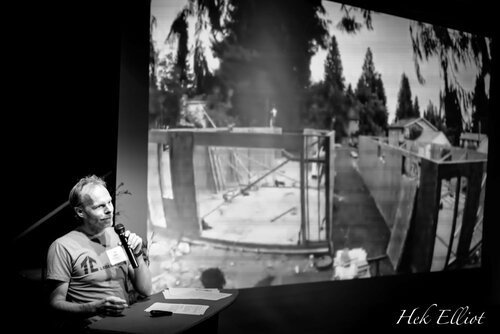
Ted presented at the Built Green Conference 2018 in Seattle. He shared the podium with homeowners Andri Kofmehl and Veena Prasad. Their topic, Bridging Innovation and Affordability: How to Build the Greenest House Possible Without Compromising on Aesthetics or Breaking the Bank, featured our 2017 Emerald Star home. More details on this can be found at this link to our portfolio.
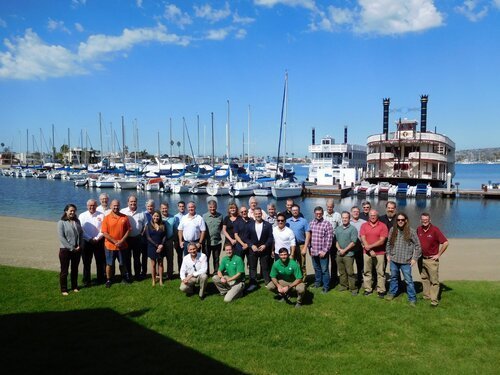
Craig and Thad did a little San Diego couch surfing to attend a Builder’s Round Table, composed entirely of 2018 Department of Energy Housing Innovation Award Winners, where we learned a little about the future of high-performance building.
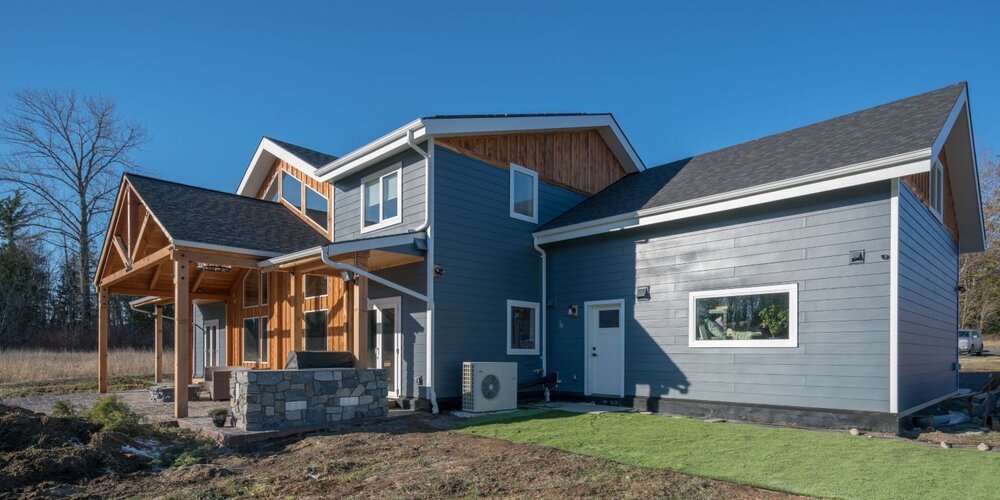
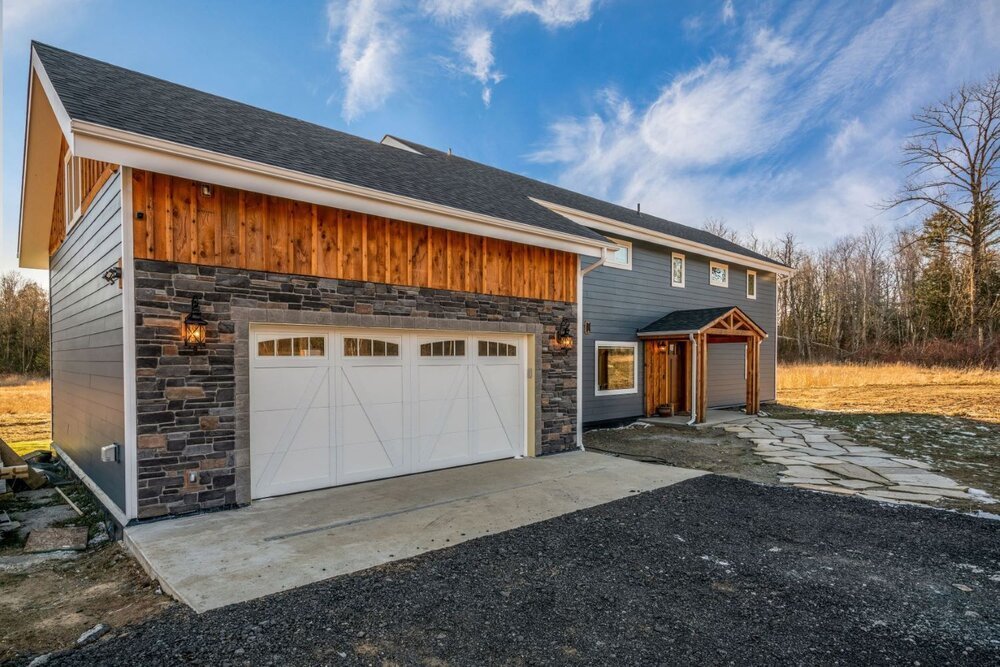
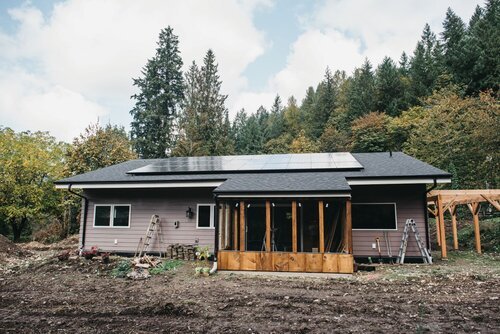
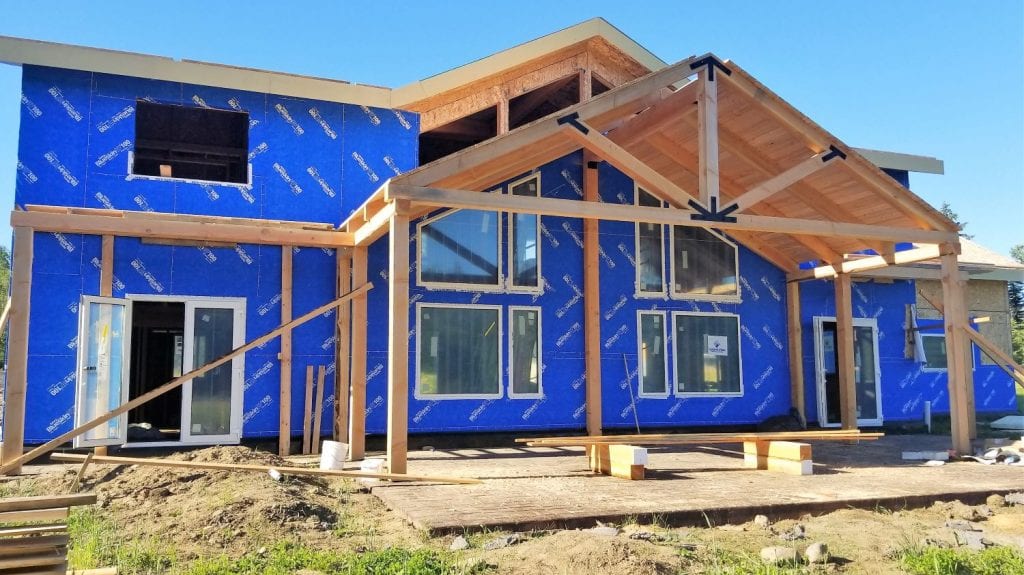
We participated in the Whatcom County Showcase of Homes, featuring the second home shown above – a great example of an affordable net-positive home in Bellingham. You can also read more about it in our portfolio.
Ted and Thad spoke at the Northwest EcoBuilding Guild’s annual Green Building Slam about how building net-positive can actually make it easier to afford more home while preserving quality of life.
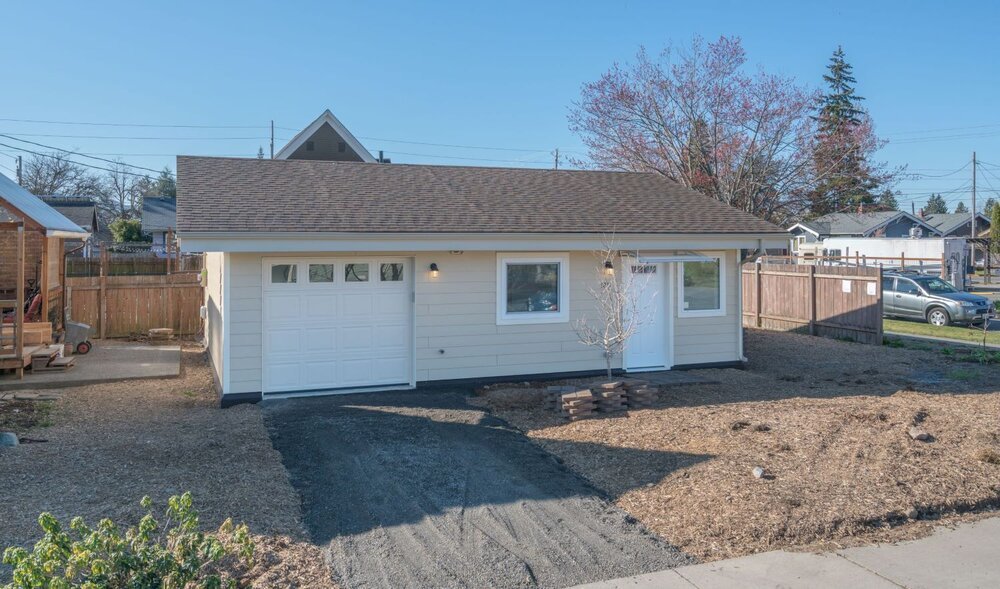
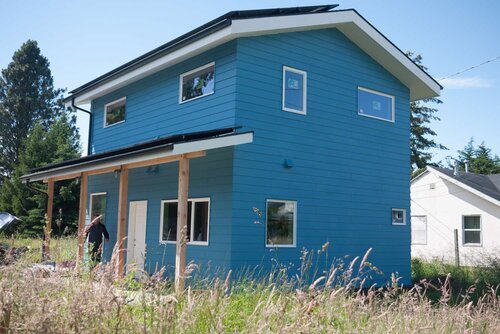
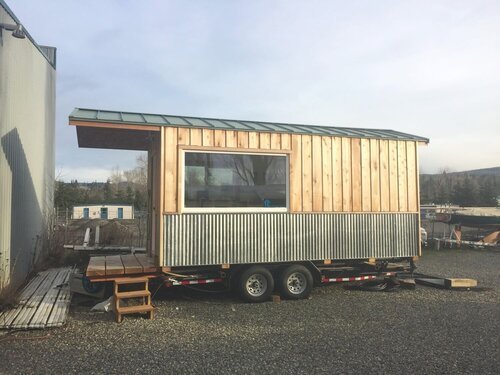
We “expanded” our business operations into a SIPs Tiny Office (above).
Ted wrapped up his speaking engagements in December, at the Sustainable Connections Green Building Slam, with a talk about why we need to embrace sustainable building – because Our Kids are Going to Need a Place to Live.
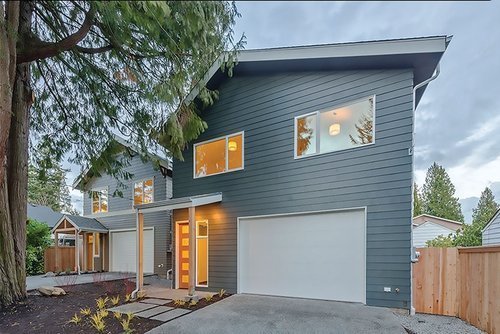
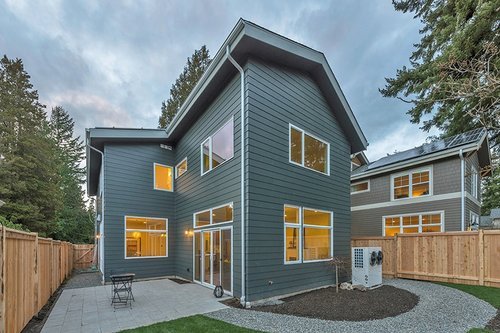
TC Legend Homes built this 2,463-ft2 home in Seattle, Washington, to the performance criteria of the DOE Zero Energy Ready Home (ZERH) program. The two-story home has SIP walls and triple-pane windows for draft-free construction and high insulation values.
Project Data
Name: 19th Avenue
Location: Seattle, WA
Layout: 4 bdrm, 2.5 bath, 2 fl, 2,463 ft2
Climate Zone: IECC 4C, marine
Completion: May 2016
Category: custom for buyer
Modeled Performance Data
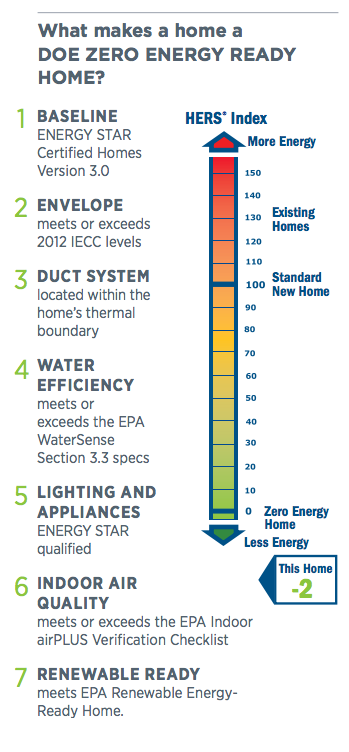
HERS Index: without PV 44, with PV -2
Projected Annual Energy Costs: without PV $1,053, with PV $25
Projected Annual Energy Cost Savings (vs home built to 2012 IECC): without PV $811, with PV $1,889
Projected Annual Energy Savings: without PV 9,453 kWh, with PV 20,993 kWh
Added Construction Cost: without PV $0
When a net-zero-energy home can be built at a cost on par with traditional construction, everyone wins. TC Legend Homes is helping to usher in a new era of green construction in which home owners don’t have to choose between cutting-edge efficiency and staying on budget.
“Over the last decade, we’ve developed practices that allow us to build net-zeroenergy homes for the same price as traditionally constructed homes. Sometimes, we are able to build them for even less,” said TC Legend Homes’ owner and lead Ted W. Clifton, Jr.
“We know we are doing something right because our services are in high demand,” said Clifton, who is headquartered in Bellingham, Washington, but also builds in the Seattle area.
One way TC Legend Homes is achieving net zero is by building to the high performance criteria of the U.S. Department of Energy’s Zero Energy Ready Home program. DOE has honored the builder with four Housing Innovation Awards since 2013, including a grand award in 2014 in the affordable category and a 2016 award in the custom home category. The 2016 award-winner is a two-story, 2,463-ft² home located next to another TC Legend Home on an urban infill lot in Seattle.
The high-performance features of this home, combined with the 9.5-kW PV system and solar water heating, help the home achieve a Home Energy Rating System (HERS) score of minus 2. That equates to calculated annual utility costs of $25 (counting service charges) or enough electricity to power the all-electric home. If the home performs better than calculated, it will cover the power for the electric car charging station in the garage as well. Even without the PV, the home would achieve a HERS score of 44, far better than the HERS 80 to 100 of typical homes.
Clifton is used to getting such scores. He has been certifying homes to the DOE Zero Energy Ready Home program since 2013. His previous winning homes have HERS scores ranging from -12 to 13 with PV or 34 to 43 without PV. Clifton has committed to building all of his future homes to the program.
The DOE Zero Energy Ready Home program requires homes to meet all of the requirements of ENERGY STAR Certified Homes Version 3.0 and the U.S. Environmental Protection Agency’s Indoor airPLUS program as well as the hot water distribution requirements of the EPA’s WaterSense program and the insulation requirements of the 2012 International Energy Conservation Code. In addition, homes are required to have solar electric panels installed or have the conduit and electrical panel space in place for future photovoltaic panel installation.
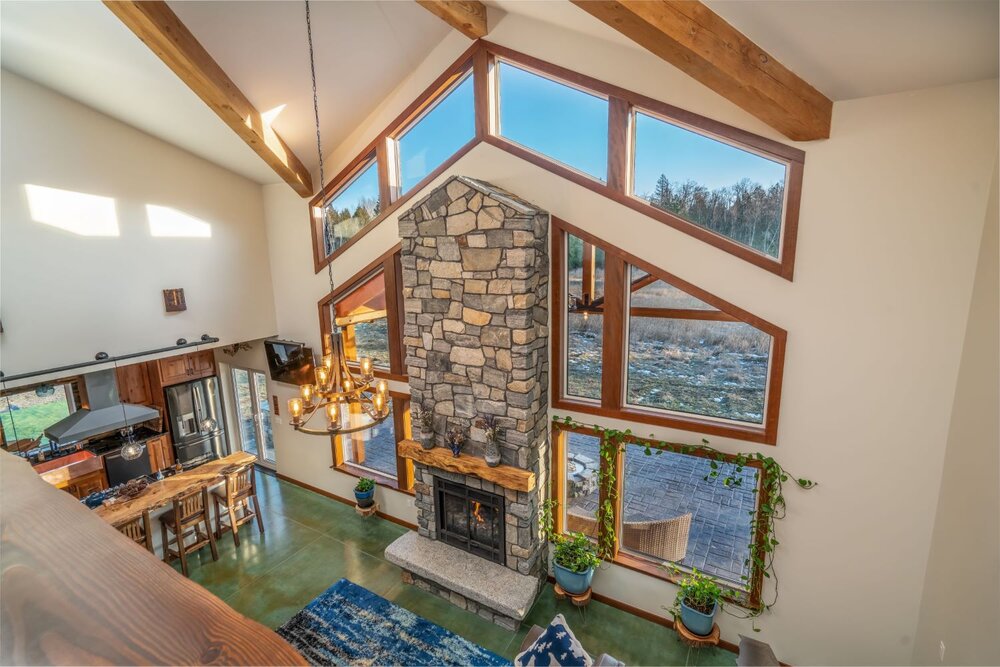
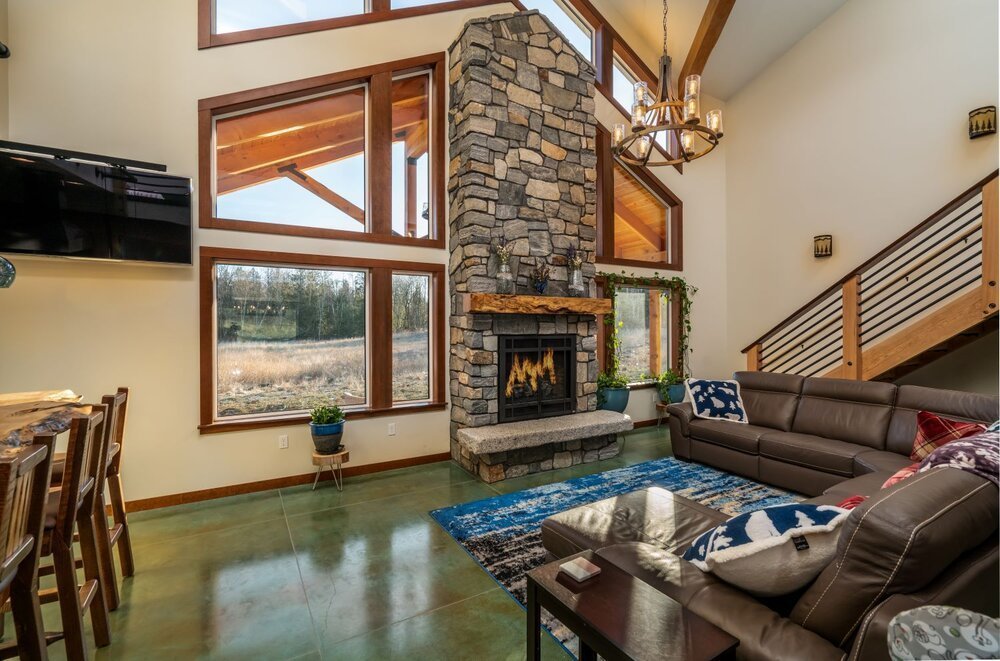
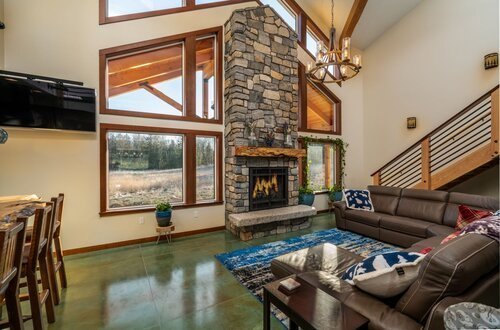
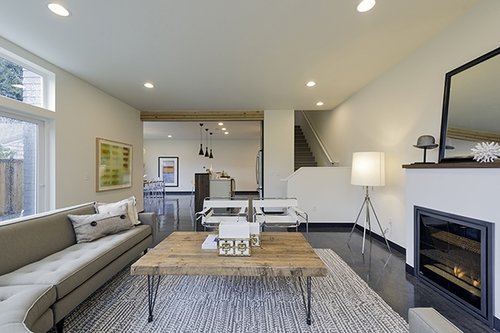
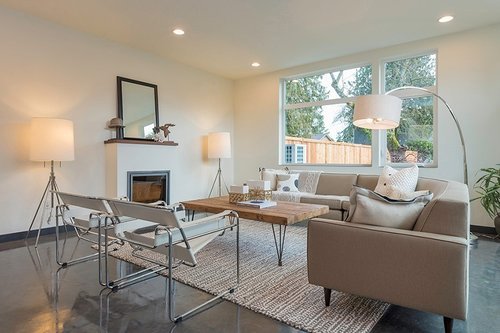
The 2016 award-winning home was situated on the northern edge of the lot to maximize southern exposure. “Our houses are designed from the ground up to take advantage of the sun. A passive solar layout like the one in this house means lots of windows facing south and few facing north,” said Clifton. The long axis of the house is east to west to allow for maximized solar exposure for the PV and solar hot water systems and for passive solar heating. High-quality triple-paned, vinyl-framed windows were located on the south side of the house to maximize solar heat gain. The builder polishes and stains the concrete floor slab to use as the finished flooring; its thermal mass absorbs heat from the sun during the day and slowly releases it at night to provide beneficial passive solar heating.
Structural insulated panels (SIPs) were used for the walls and roofs. “We chose SIPs for their excellent insulation values, airtightness, and ease of construction,” said Clifton. SIPs consist of two layers of OSB sandwiching a layer of rigid expanded polystyrene foam. They arrive from the factory as 4×8-foot sheets or precut for doors and windows as required for each wall. Clifton uses locally made panels that come precisely cut, allowing for fast construction, a strong, airtight shell, and practically zero jobsite waste. The TC Legend Homes crew is trained in SIPs construction, which helps assembly go smoothly. Clifton has used SIPs ever since he began constructing homes with his father, Whidbey Island builder and designer Ted L. Clifton, while in high school. Ted Clifton Jr. is on site daily to oversee every step of the TC Legend home construction process, allowing for any problems to be quickly fixed.
For the winning home’s walls, Clifton specified R-29, 6-inch SIPs that are glued and taped at all interior and exterior joints. The panels are covered with house wrap that is overlapped and taped to serve as a drainage plane under the fiber cement siding. The roof decking consists of R-42, 10-inch SIPs, also taped at all interior and exterior joints. The whole roof deck is covered with self-adhering ice-and-water shield, which provides a weather-resistant layer under the asphalt shingles. There is no attic in the home. Because the SIP panels provide the insulation and roof decking in one layer, all of the home’s upper-floor rooms can have vaulted ceilings.
The home has a slab-on-grade foundation with stem walls made of insulated concrete forms (ICFs) that wrap the sides of the slab in R-23 of insulation while an R-20 layer of rigid foam covers the ground under the entire slab. Seams are taped and the rigid foam layer serves as the vapor barrier between the ground and the home.
The concrete floor slab contains radiant floor loops. Water for the radiant floor heating is provided by the roof-mounted evacuated tube solar hot water system and by an ultra-efficient air-to-water heat pump with a coefficient of performance (COP) of 4.5. These systems also provide domestic hot water. The heat pump’s indoor unit is centrally located on the main floor. Low-flow fixtures help cut water usage.
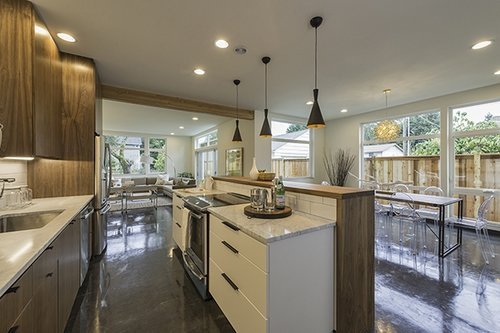
ENERGY STAR-rated appliances also reduce water and energy usage. All of the home’s lighting is provided by LEDs, adding to energy savings. The home was assessed by a home energy rater per DOE Zero Energy Ready Home requirements and showed air leakage of only 0.60 air changes per hour at 50 Pascals. That’s equivalent to the Passive House Institute U.S. Standards and three times tighter than required by the newest energy code. (The 2015 International Energy Conservation Code requires 3 ACH 50 or less.)
To provide good ventilation for the home, the builder installed timered exhaust fans to provide spot ventilation in the four-bedroom home’s 2.5 bathrooms. The range hood fan is timer controlled with a 200-cfm fan that pulls fresh air into the home through a vent located downstairs on the north side of the home. Both fans can be set to come on for balanced ventilation during the day and for night-time cooling in the summer.
Use of low- and no-VOC paints, finishes, and flooring and good moisture management practices like site grading and drainage were among the measures the builder installed to comply with the requirements of the EPA’s Indoor airPLUS checklist.
Home Certifications
DOE Zero Energy Ready Home Program, 100% commitment
ENERGY STAR Certified Homes Version 3.1
EPA Indoor airPLUS
In a “green” market like the Pacific Northwest, marketing DOE Zero Energy Ready Homes is easy. TC Legends has found it gets more than enough customers through these avenues: 1) referrals from other customers; 2) TC Legends’ website; 3) TC Legends’ presence on other websites, for example the DOE Tour of Zero and Housing Innovation Awards sites; and 4) participation in the annual Northwest EcoBuilding Guild’s Green Home Tour.
“Because TC Legend Homes builds custom homes, most of our potential customers approach us already wanting an energy-efficient home. We educate our customers about how our homes are different from most houses and about how we achieve net-zero energy and positive energy in the homes we build,” said Clifton. “By conserving as much energy as possible, these homes will be able to offset more than 100% of their electricity usage with the roof-sized solar electric systems.” said Clifton.
By value engineering and fine-tuning their processes, TC Legends is able to achieve zero energy at surprisingly low cost. “We only do net zero energy construction, and for less than most builders in the area do regular construction. We average $200/ft² including solar,” said Clifton.
Key Features
DOE Zero Energy Ready Home Path: Performance.
Walls: R-29, 6″ SIP taped at all interior and exterior joints, fiber cement siding.
Roof: R-42, 10″ SIP taped at all interior and exterior joints. Ice-and-water shield, asphalt shingles.
Attic: None.
Foundation: R-23 ICF stem walls, R-20 rigid foam under slab.
HVAC: Evacuated tube solar hot water and 4.5 COP air-to-water heat pump for in-floor radiant hydronic heat.
Hot Water: Air-to-water heat pump, COP 4.5.
Lighting: 100% LED.
Appliances: ENERGY STAR refrigerator, clothes washer, range hood; induction cooktop.
Solar: 9.5-kW PV, evacuated tube solar hot water.
Water Conservation: Low-flow fixtures; centrally located water heater.
Other: Low-VOC paints and finishes.
Electric vehicle charging stati
The U.S. Department of Energy invites home builders across the country to meet the extraordinary levels of excellence and quality specified in DOE’s Zero Energy Ready Home program (formerly known as Challenge Home). Every DOE Zero Energy Ready Home starts with ENERGY STAR Certified Homes Version 3.0 for an energy-efficient home built on a solid foundation of building science research. Advanced technologies are designed in to give you superior construction, durability, and comfort; healthy indoor air; high-performance HVAC, lighting, and appliances; and solar-ready components for low or no utility bills in a quality home that will last for generations to come.
For more information on the DOE Zero Energy Ready Home program go to https://energy.gov/eere/buildings/zero-energy-ready-home





Recent Comments