Home Energy Rating System
Written by: Sarah DesRosiers
How energy efficient is YOUR home? There are many factors that contribute to a home’s energy efficiency. These factors include the home’s building structure such as insulation, windows, and doors. It also includes the efficiency of appliances and lighting as well as the occupant’s living habits. For example, does the occupant turn down the thermostat when leaving the home or unplug appliances when not being used? In addition to the building structure of a home, the building orientation or how the home is positioned, on site, plays a role in how the home performs energy wise. How We Use Site Orientation to Maximize Energy Efficiency
According to the US Department of Energy US DOE, homes and buildings in the US consume 40% of the energy in our country. On average, Americans spend around $2000.00 per year on energy. Not only does energy efficiency matter because of the expense, but when it’s considered in your building practices, it improves the quality of living in the space; making it more comfortable
What is HERS? HERS stands for Home Energy Rating System. It is a way to measure your home’s energy efficiency by testing the Heat Recovery System. How does it work? A HERS Index rating is determined by a certified RESNET HERS Rater. The steps to determine a home’s HERS rating is a multi-step review of a home’s energy usage/performance. The first step involves a pre-construction or pre-inspection plan review where the HERS Rater inputs floor plans, building materials, HVAC equipment, windows/doors and insulation plans into an approved energy software, which predicts a HERS Index prior to the build. Next, the certified HERS rater inspects a project at a couple different stages of the project. An inspection is performed at the pre-drywall phase and then again at the home’s completion to test the buildings performance. The final diagnostic testing is the way in which the final HERS rating is determined. During this final inspection, several diagnostic tests are performed. First, a Blower Door Test is done where a calibrated fan is placed in an exterior doorway. The home is then depressurized. The fan can then measure how much air leaks through the exterior envelope of the home. Secondly, the certified Rater will perform a Duct Leakage Test where a duct blaster is used to pressurize the ducts and measure the leakage to the outside. Thirdly, the Rater inspects the insulation installation to determine air barrier continuity. The fourth inspection includes the Mechanical System Verification where the Rater considers the HVAC type and its efficiency, the water heater efficiency, the ventilation systems, and the efficiency of appliances and lighting. With all the above testing, the Rater determines a final calculation of the HERS index. The final HERS Index score reports the home’s energy use breakdown, projected cost of utilities, efficiency recommendations, and test result of duct leakage.
What does the HERS Score actually mean? According to RESNET HERS INDEX, the lower the HERS score, the more efficient the home. A HERS rating of 100 is equivalent to a standard home built to code. A score of 50-60 is a build that performs above average. Every point under 100 is 1% more efficient. A HERS 0 is a Zero Energy home, which means the home requires no additional power. Essentially, it’s a home that produces enough electricity to offset what it uses and a HERS <0 is a Net-Positive energy home meaning that the home produces more power than it uses. Imagine charging your electric car AND still having a $0.00 power bill at the end of the month; this is a Net-Positive Home.
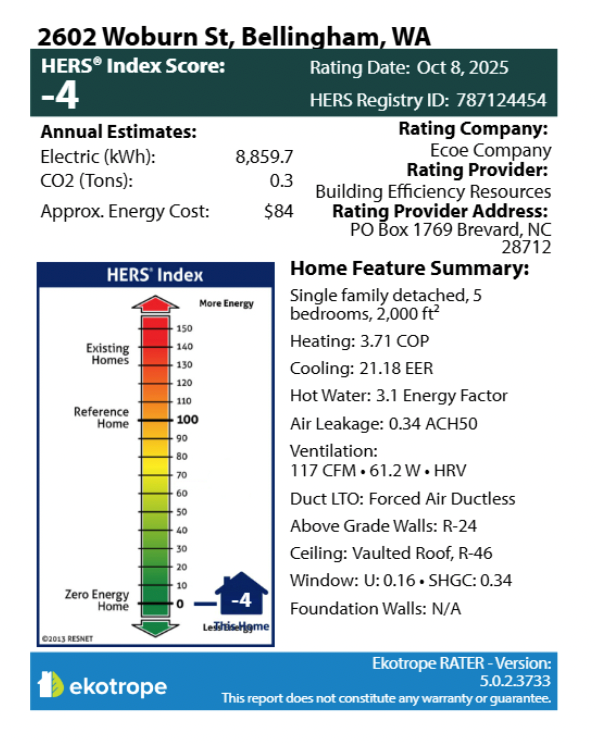
At Legend Homes, we build award winning Net Zero and Net Positive Energy Homes. A HERS rating is important in determining just how energy efficient a build is upon completion. Our most recent spec home has a HERS rating of -4, which means that this home is Net-Positive. The image depicts the HERS rating score for this recent build.
A HERS rating is essentially the gas mileage rating of a vehicle, but for a home. It is the best gauge in determining the quality of the invisible or internal workings of a home. At Legend Homes, we use EPS foam in SIP’S panel walls and roof systems to create a super insulated envelope. FAQ’s about SIPS We use insulated concrete forms or ICF’s to complete the envelope in the ground around the footprint. Additionally, we use high efficiency triple pained windows as well as the most efficient electric heat pumps available in North America. We orient our homes to the sun to capitalize on solar exposure for both solar panels and solar heat gain. We look for High R-values and air seal our homes. We use a process called aero barrier, which is a process that involves pressurizing a home and misting latex particles into the air that collect and seal any unseen cracks. We use HRV’s (heat recovery ventilation system) that harvest warm conditioned air from the inside of the house and transfer it to fresh air being brought into the house. This allows for high air quality in combination with energy conservation. How We Build for Energy Efficiency
Building an energy efficient home requires so much more than simply adding solar panels to a roof. There’s a lot of buzz around Green Building and we want consumers to be aware of misleading advertising often referred to as “Greenwashing” where products are advertised as environmentally friendly or Green when they really are not. Solar power is an important piece, but only one factor in achieving a true Green Built Home. Our award-winning Green Built Homes are designed in a manner where every part of the design is geared toward achieving a Zero Energy/Net Positive outcome.
At Legend Homes, we build houses that are not only comfortable to live in, beautiful to the eye, but also inexpensive to run and better for the planet! Why Sustainable Housing Is Important