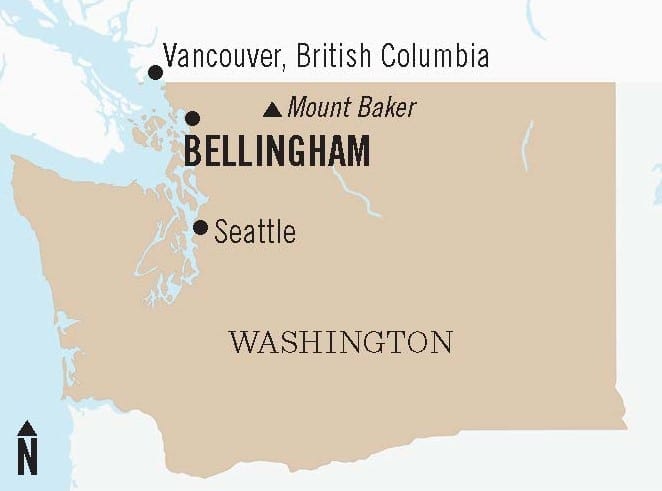
Bellingham has a moderate climate and rooftop solar panels can supply the energy required to heat a home in winter & cool that home in summer.
1. Bellingham has a moderate climate
With an average of 3.5 hours of sunshine a day, Bellingham is an ideal place to build a net zero home. Surprisingly, 10kW of rooftop solar panels can supply the energy required to heat a 2000sf house in winter, and cool that house in summer.
The stabilizing presence of the Pacific Ocean maintains moderate temperatures, ensuring Bellingham doesn’t suffer the weather extremes experienced in other parts of the USA. With wintertime averages of 48 degrees, only 20 degrees of heating is needed to get to a comfortable 68 degrees inside.
Summertime averages vary between 70 and 80 degrees. Some folks want air conditioning & others do not. Either way, little energy is needed and that energy can be made on the roof of a net zero house.
2. Land has recently become available
The Middle Housing ordinance came into effect in Bellingham in late 2025. The new ordinance allows construction of additional houses in the backyard of any existing home zoned ‘Residential Single’, which is a lot of lots!
Lowering housing costs and making more land available is the goal of the Middle Housing code.
Lots zoned ‘Residential Single’ can build 4 additional dwellings in the yard. There are rules but importantly, those additional homes can be condominium-ized so they can be sold separately from each other & the original house.
We will blog more about this next week.
3. Legend Homes has expertise in building net zero homes
Legend Homes has built over 40 Net Zero homes in the Pacific Northwest. The Department of Energy recognizes Legend Homes as a leading force in the construction of net zero homes.
Legend Homes builds net zero homes for same price as conventional custom homes. By directing the design process Legend Homes simplifies the design for efficient construction and then allocates the savings to superior insulation and solar panels.
4. Powerhouse Designs has expertise in designing & permitting net zero homes
The skills needed to design, permit & build a net zero home are all present in the Bellingham area. Legend Homes has a sister company Powerhouse Designs which has designed & permitted over 50 net zero houses.
Landowners can employ Powerhouse Designs to undertake full-service development of a parcel of land for a net zero home:
Planning a site involves managing surveying, locating wells and septic systems, installing grid power, often managing biologist reporting for wetlands, and locating the home on the lot.
Planning a home involves 3d drafting with the homeowners. Importantly, all house designs & all site-work components (i.e. septic system and well) are costed throughout the design process so the design fits the client budget.
When a client is finished with Powerhouse Designs, they will have home plans, all needed permits, & a build contract.
5. Net metering is available
A net zero home in the Pacific Northwest needs a grid connection to send excess summertime solar-panel energy to the grid for immediate use. A net metering agreement with the grid allows summertime energy over-production to be banked and drawn back when needed in the winter. If the summertime production equals the wintertime draw, then the house is net zero.
Washington has a well-developed electrical grid with connections available in most places. There is commitment from PSE, the major electrical utility, to continue fairly priced net metering.
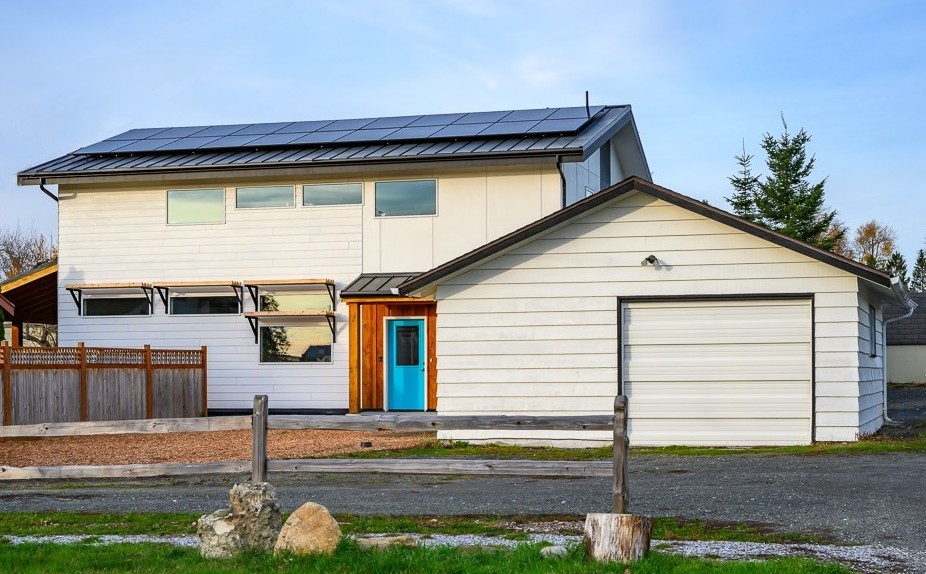
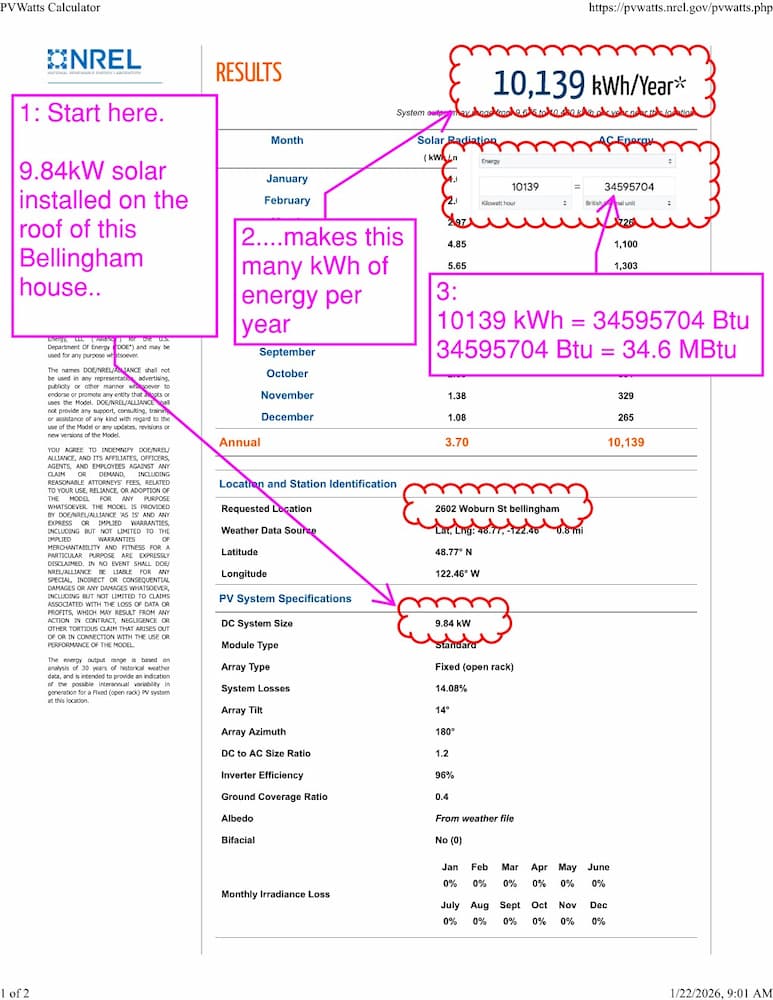
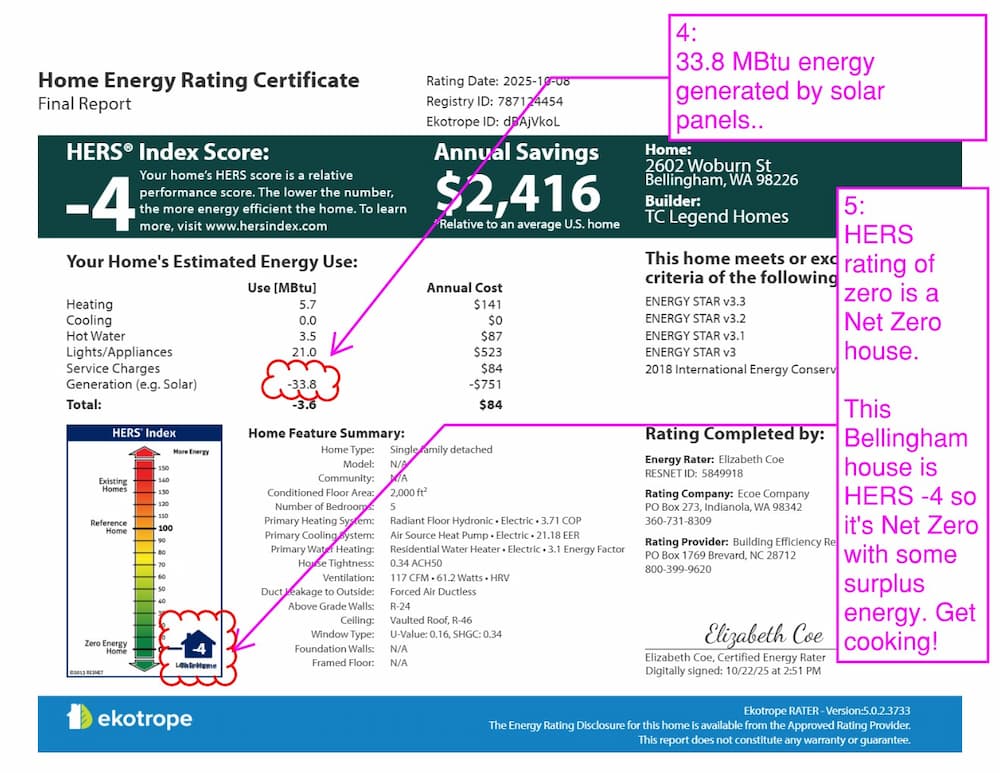
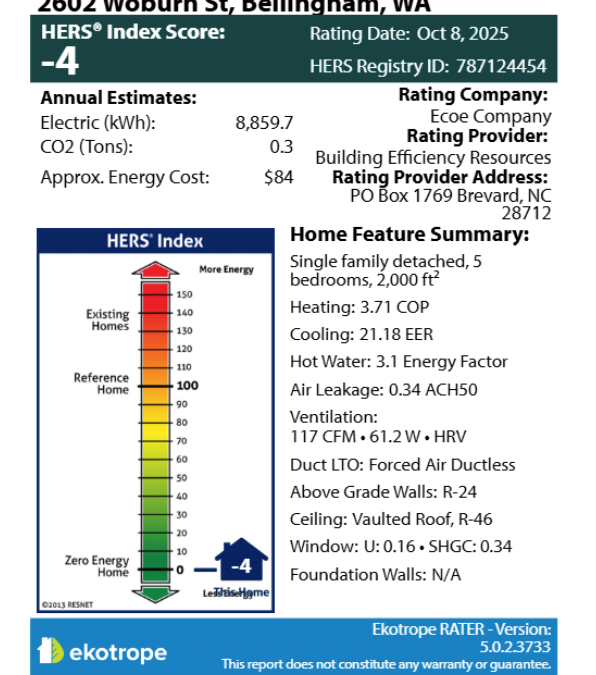
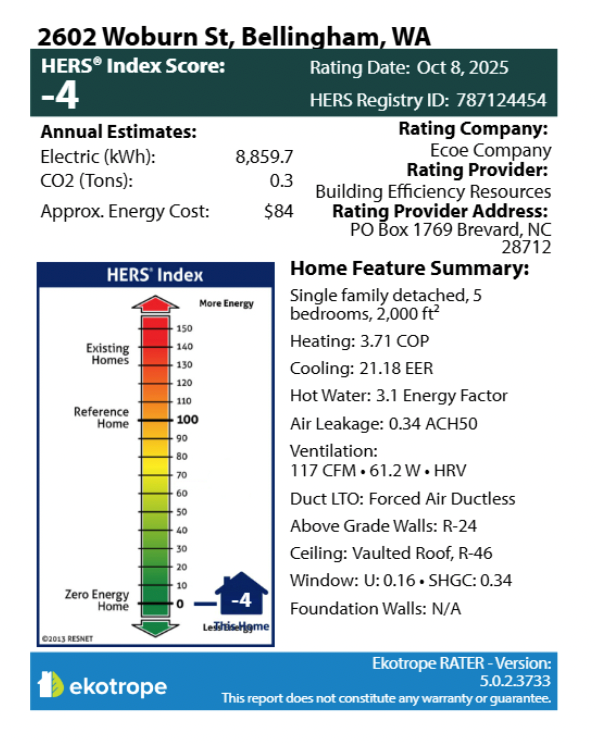
The 2000sf Woburn House is certified net zero, built in 2025 by Legend Homes in Bellingham.PV Watts analysis of the Woburn House showing the 9.84kW rooftop solar array will make 34.6MBtu of electrical energy per year.The certified -4 HERS rating for the Woburn House proves the 33.8 MBTU of electrical energy made on the roof will supply all the energy needs for the house for a year.
Still have questions? Shoot us an email! We’d be more than happy to answer any questions you have!
Net zero homes generate all their own energy. Net zero houses in cold areas usually borrow energy from the grid in winter & send energy to the grid in summer.
1. Net zero houses must create energy.
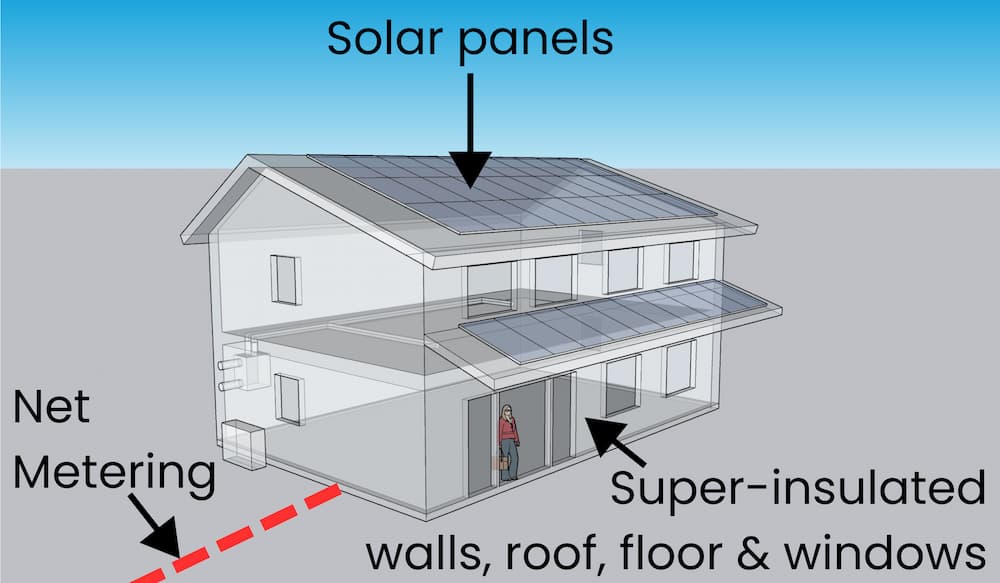
A net zero house makes all the energy it needs, so there must be a way to make renewable energy on-site. Usually the energy is created from rooftop solar panels, but there may be locations where wind power is possible.
2. Net zero houses are connected to the grid.
Net zero houses create more energy than needed during the summer, and this energy is sent to the grid for immediate use. A net metering agreement with the grid allows summertime energy over-production to be banked and drawn back in the winter. If the summertime production equals the wintertime draw, then the house is net zero.
3. Net zero houses are designed to need little energy.
Net zero houses use superior insulation, low energy appliances and careful design to ensure little energy is needed to run the house. A net zero house with low energy needs will be able to fit all the required solar panels on the roof.
Who should live in a net zero house?
There is a compelling argument for retired folks with fixed incomes to choose to live in a net zero house because there are no energy bills for heating, cooling, and electricity use. If a net zero home has extra rooftop solar panels then an electric car can be powered and the household is also free from the costs & uncertainty of gasoline bills.
Companies like TC Legend Homes build net zero homes for the same price as a conventional house.
To deliver a net zero home to the market for the same price as a conventional home, a builder must direct the design process; simplifying the design for efficient construction and then allocating savings to superior insulation and solar panels.
The main challenge for net zero construction is finding land that faces south so the roof can collect solar power from a clear sky. Great opportunities exist for net zero housing when multi house developments are planned & the lots can all be oriented towards the noon sun.
Net zero housing combines superior insulation & solar panels to deliver homes that have no energy bills, ever. In a world concerned with climate change, there is good reason to consider net zero homes for all residential construction.
Still have questions? Shoot us an email! We’d be more than happy to answer any questions you have!
How energy efficient is YOUR home? There are many factors that contribute to a home’s energy efficiency. These factors include the home’s building structure such as insulation, windows, and doors. It also includes the efficiency of appliances and lighting as well as the occupant’s living habits. For example, does the occupant turn down the thermostat when leaving the home or unplug appliances when not being used? In addition to the building structure of a home, the building orientation or how the home is positioned, on site, plays a role in how the home performs energy wise. How We Use Site Orientation to Maximize Energy Efficiency
According to the US Department of Energy US DOE, homes and buildings in the US consume 40% of the energy in our country. On average, Americans spend around $2000.00 per year on energy. Not only does energy efficiency matter because of the expense, but when it’s considered in your building practices, it improves the quality of living in the space; making it more comfortable
What is HERS? HERS stands for Home Energy Rating System. It is a way to measure your home’s energy efficiency by testing the Heat Recovery System. How does it work? A HERS Index rating is determined by a certified RESNET HERS Rater. The steps to determine a home’s HERS rating is a multi-step review of a home’s energy usage/performance. The first step involves a pre-construction or pre-inspection plan review where the HERS Rater inputs floor plans, building materials, HVAC equipment, windows/doors and insulation plans into an approved energy software, which predicts a HERS Index prior to the build. Next, the certified HERS rater inspects a project at a couple different stages of the project. An inspection is performed at the pre-drywall phase and then again at the home’s completion to test the buildings performance. The final diagnostic testing is the way in which the final HERS rating is determined. During this final inspection, several diagnostic tests are performed. First, a Blower Door Test is done where a calibrated fan is placed in an exterior doorway. The home is then depressurized. The fan can then measure how much air leaks through the exterior envelope of the home. Secondly, the certified Rater will perform a Duct Leakage Test where a duct blaster is used to pressurize the ducts and measure the leakage to the outside. Thirdly, the Rater inspects the insulation installation to determine air barrier continuity. The fourth inspection includes the Mechanical System Verification where the Rater considers the HVAC type and its efficiency, the water heater efficiency, the ventilation systems, and the efficiency of appliances and lighting. With all the above testing, the Rater determines a final calculation of the HERS index. The final HERS Index score reports the home’s energy use breakdown, projected cost of utilities, efficiency recommendations, and test result of duct leakage.
What does the HERS Score actually mean? According to RESNET HERS INDEX, the lower the HERS score, the more efficient the home. A HERS rating of 100 is equivalent to a standard home built to code. A score of 50-60 is a build that performs above average. Every point under 100 is 1% more efficient. A HERS 0 is a Zero Energy home, which means the home requires no additional power. Essentially, it’s a home that produces enough electricity to offset what it uses and a HERS <0 is a Net-Positive energy home meaning that the home produces more power than it uses. Imagine charging your electric car AND still having a $0.00 power bill at the end of the month; this is a Net-Positive Home.
At Legend Homes, we build award winning Net Zero and Net Positive Energy Homes. A HERS rating is important in determining just how energy efficient a build is upon completion. Our most recent spec home has a HERS rating of -4, which means that this home is Net-Positive. The image depicts the HERS rating score for this recent build.
A HERS rating is essentially the gas mileage rating of a vehicle, but for a home. It is the best gauge in determining the quality of the invisible or internal workings of a home. At Legend Homes, we use EPS foam in SIP’S panel walls and roof systems to create a super insulated envelope. FAQ’s about SIPS We use insulated concrete forms or ICF’s to complete the envelope in the ground around the footprint. Additionally, we use high efficiency triple pained windows as well as the most efficient electric heat pumps available in North America. We orient our homes to the sun to capitalize on solar exposure for both solar panels and solar heat gain. We look for High R-values and air seal our homes. We use a process called aero barrier, which is a process that involves pressurizing a home and misting latex particles into the air that collect and seal any unseen cracks. We use HRV’s (heat recovery ventilation system) that harvest warm conditioned air from the inside of the house and transfer it to fresh air being brought into the house. This allows for high air quality in combination with energy conservation. How We Build for Energy Efficiency
Building an energy efficient home requires so much more than simply adding solar panels to a roof. There’s a lot of buzz around Green Building and we want consumers to be aware of misleading advertising often referred to as “Greenwashing” where products are advertised as environmentally friendly or Green when they really are not. Solar power is an important piece, but only one factor in achieving a true Green Built Home. Our award-winning Green Built Homes are designed in a manner where every part of the design is geared toward achieving a Zero Energy/Net Positive outcome.
At Legend Homes, we build houses that are not only comfortable to live in, beautiful to the eye, but also inexpensive to run and better for the planet! Why Sustainable Housing Is Important
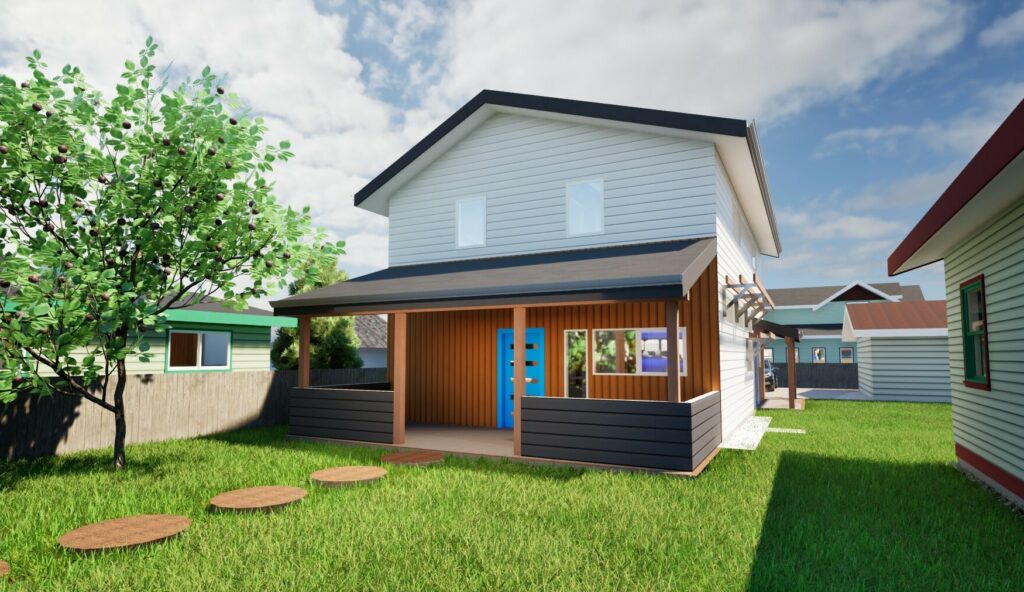
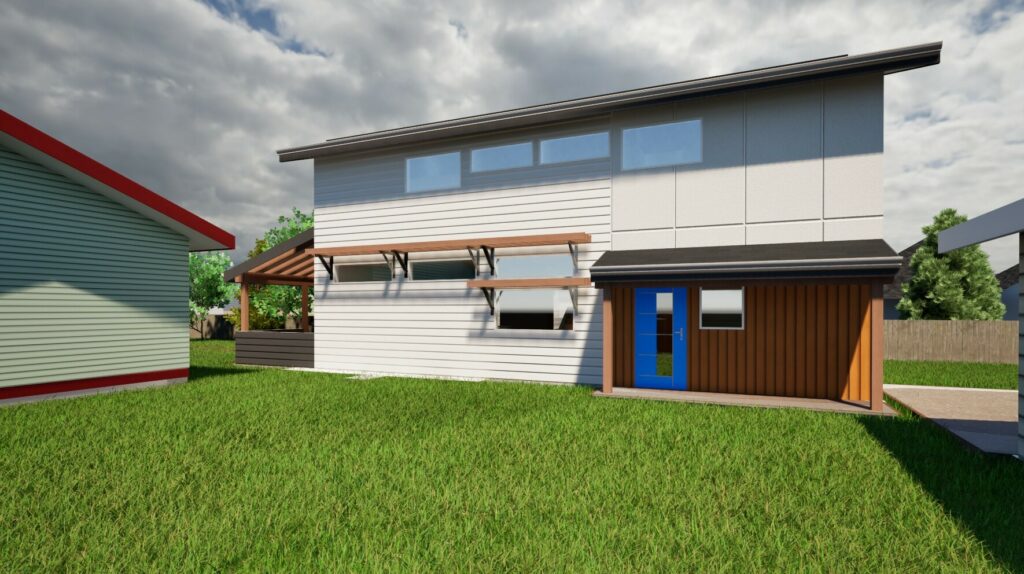
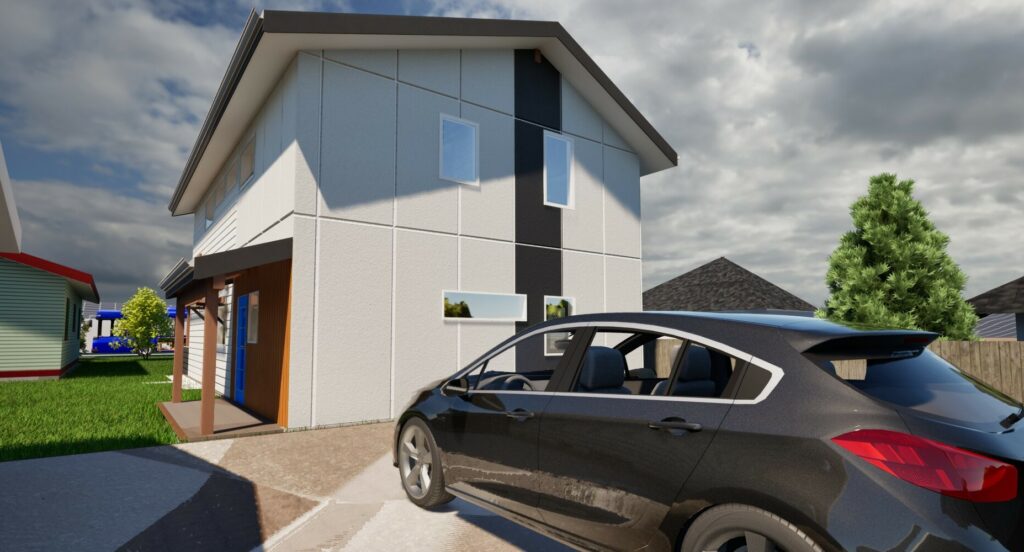
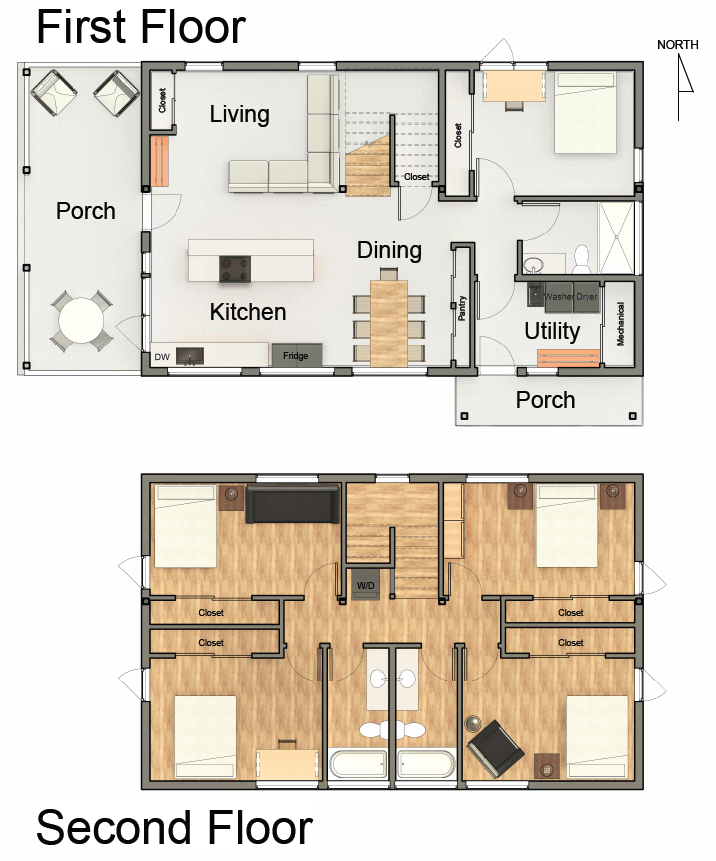
We are excited to announce our Net Zero Energy Co-Housing spec project that’s currently under construction!
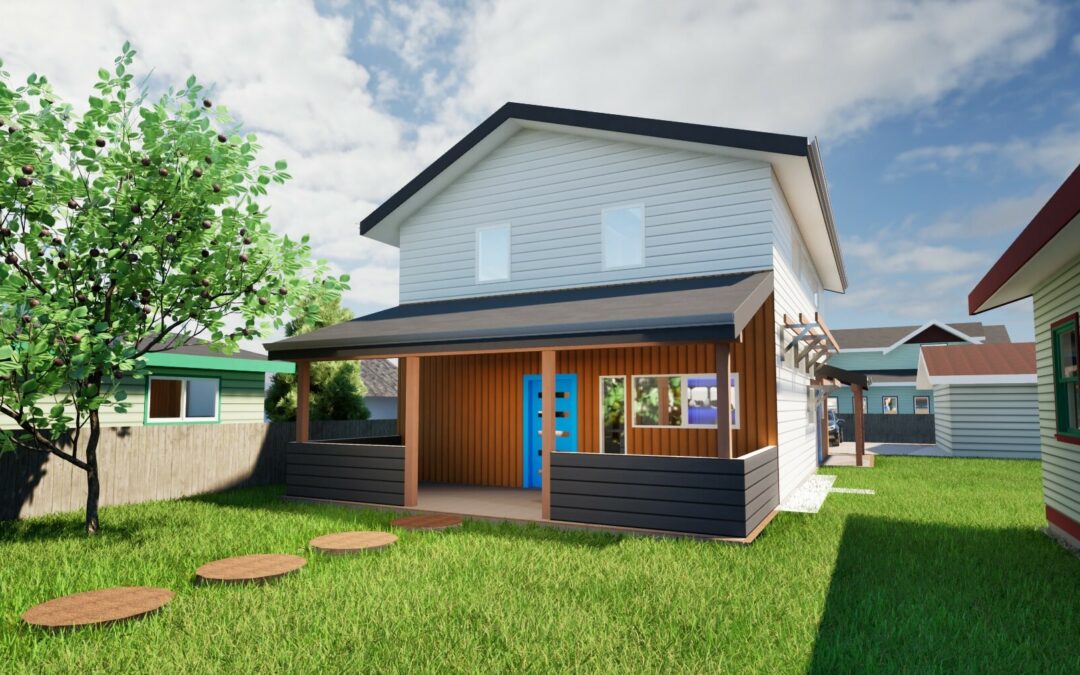
Titled “Woburn House” on our social media, this 5-bedroom home is intended to house multiple family units and has an accessible first-floor bedroom and bathroom. Our hope is for this to be a multigeneration home creating a small, tight-knit community.
As always, this home will create its own power, leaving the residents with zero electric bills. We also anticipate it will receive Built Green 5-Star, Indoor AirPlus, EnergyStar, and Zero Energy Ready Home certifications.
Once completed, this home will be open for lease or purchase!
There seems to be a lot of confusion around Structural Insulated Panels (SIPs) in home building. In this article, we will run through the most common questions we’ve seen!
Are SIPs panels non-combustible? / Are SIPs panels fire resistant?
While SIPs can still catch fire, they are less combustible than traditional stick-framed homes. That’s, in part, due to less wood being used and because of the flame retardants used on the foam. In combination with the gypsum drywall, the whole assembly has a 1-hour fire rating. SIPs construction also does not require an attic space, which can be a fire hazard, thereby eliminating a major threat.
How are SIPs panels made?
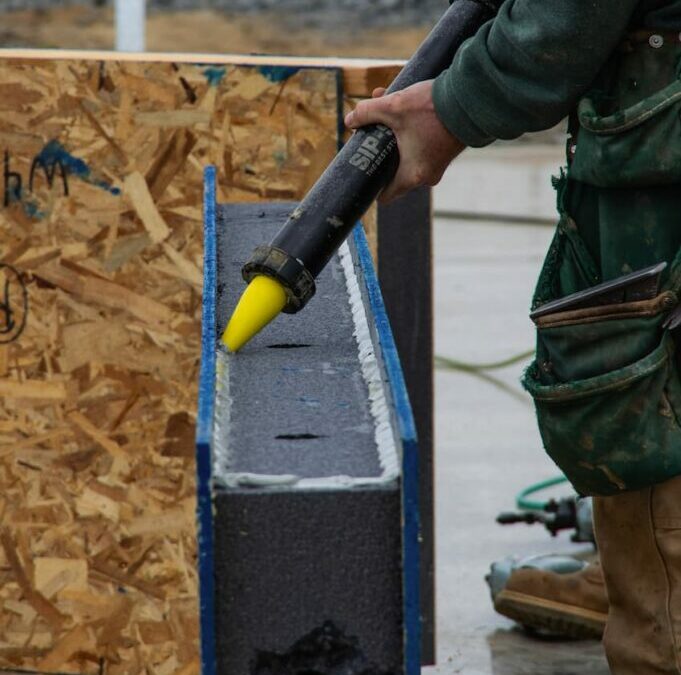
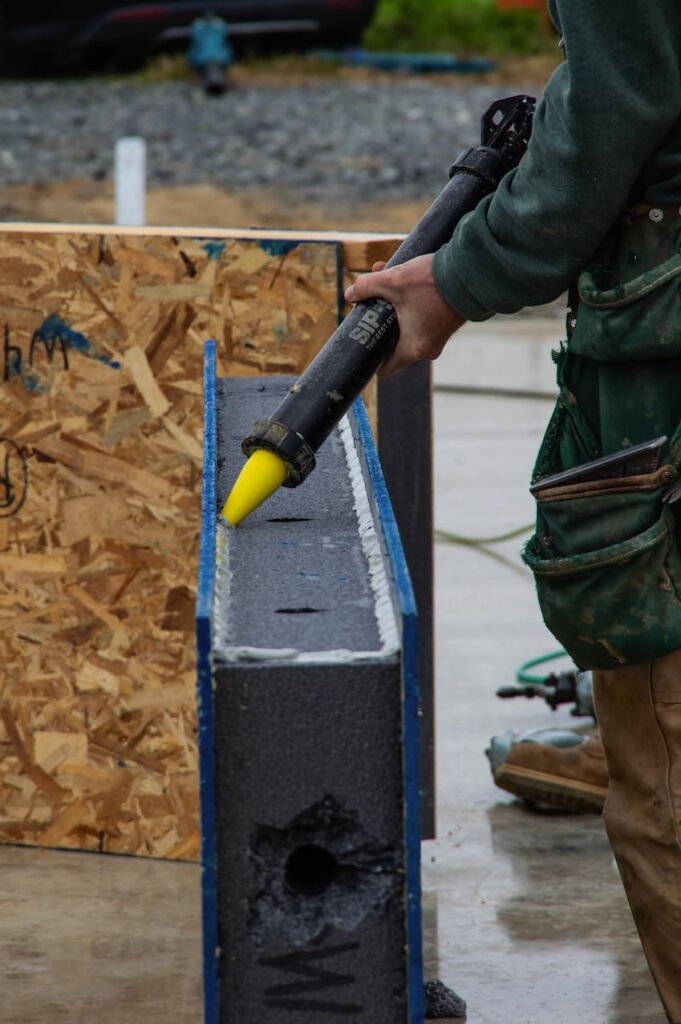
SIPs are manufactured off-site to the exact specs of the house. Each panel is made up of two OSB panels sandwiching an EPS or GPS foam core. During the manufacturing process, workers cut out each window and door opening and cut all of the pieces perfectly to size, so that when they are installed on site, they will fit together perfectly like Legos. This also means that the panel off-cuts can be recycled and reused at the manufacturing plant, reducing the overall waste!
Are SIPs panels load bearing? / Are SIPs panels structural?
Yes! SIPs can be used for the entire exterior shell of a house. According to Insulspan, “SIPs have structural properties similar to that of a steel I-beam.” In fact, SIPs are actually considered more structurally sound than traditional stick-framed homes.
Are SIPs panels environmentally friendly?
Yes! SIPs are generally considered to be more environmentally friendly than traditional stick-framed homes. That being said, SIPs can use either EPS or GPS foam cores and EPS is not a very eco-friendly option. So, it’s best to use GPS SIPs in order to lessen the home’s overall carbon footprint. Also, since SIPs are manufactured off-site, they are made to the specific dimensions of a home which reduces the waste. Any scraps produced during manufacturing are also reused. Furthermore, when shipped, the panels are tightly flat-packed together reducing fuel needed for transportation.
Can SIPs panels get wet?
Yes! SIPs are built to dry out and can withstand exposure to the elements for many months. The foam core doesn’t absorb water unless it’s physically submerged or constantly wet for a long time. In all the years we’ve built using SIPs in the rainy Pacific Northwest, we have never had an issue with the SIPs compromising due to moisture.
How long will a SIPs house last?
SIPs are a super sturdy and hardy building material. Assuming you are properly maintaining your house (i.e. replacing your roof every 30-50 years, fixing any broken siding or trim, fixing leaks as soon as they happen, etc.), then a SIPs house will last 100+ years.
Still have questions? Shoot us an email! We’d be more than happy to answer any questions you have!

Recent Comments