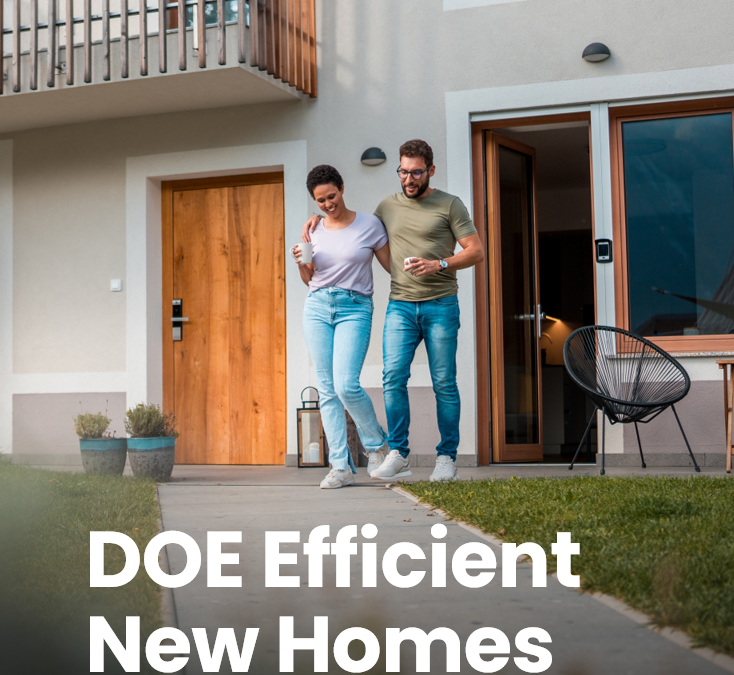
The US Department of Energy has a new certification for newly constructed homes, focusing on promoting energy efficiency.
Every US Department of Energy Efficient New Home meets rigorous efficiency and performance criteria found in the DOE ENH National Program Requirements. Most types of new homes in the U.S. are eligible to participate in the program, and the homes are verified by a qualified third-party as part of the certification process.
Designed to deliver truly best-in-class performance, homes that meet the Efficient New Homes program requirements allow buyers to immediately recognize when a home has been certified through the rigorous efficiency and performance third-party verification process. The outcomes of that process mean homes include:
Energy-efficient heating, cooling, appliances, plumbing, windows, and lighting, which leads to lower bills and better air quality
Advanced insulation, air sealing, quiet window technology, and high-performance appliances, fans, and lighting that create a quiet, comfortable environment
Advanced building materials and products throughout the house that are proven to last.
Peace of Mind
Every Efficient New Home is fully inspected by multiple third-party, certified professionals. This means your home will meet and exceed the highest levels of performance—for everything from insulation to non-toxic paints.
Better Living
What makes an Efficient New Home different?
Air sealing to block dust, pollen, and pests.
Construction materials with low or no chemical content.
Water protection from roof to foundation minimizes moisture-related health problems and mold.
Better indoor air quality
…and the list goes on and on.
Best in Class Technology
DOE Efficient New Homes exceed current building codes across every element—and some technologies are decades ahead.
From high performance windows, to #energyefficient appliances, to future -ready infrastructure, you and your wallet will notice the difference with a DOE Efficient New Home.
To learn more about the Efficient New Homes Program go to the ENH website for more information.
How energy efficient is YOUR home? There are many factors that contribute to a home’s energy efficiency. These factors include the home’s building structure such as insulation, windows, and doors. It also includes the efficiency of appliances and lighting as well as the occupant’s living habits. For example, does the occupant turn down the thermostat when leaving the home or unplug appliances when not being used? In addition to the building structure of a home, the building orientation or how the home is positioned, on site, plays a role in how the home performs energy wise. How We Use Site Orientation to Maximize Energy Efficiency
According to the US Department of Energy US DOE, homes and buildings in the US consume 40% of the energy in our country. On average, Americans spend around $2000.00 per year on energy. Not only does energy efficiency matter because of the expense, but when it’s considered in your building practices, it improves the quality of living in the space; making it more comfortable
What is HERS? HERS stands for Home Energy Rating System. It is a way to measure your home’s energy efficiency by testing the Heat Recovery System. How does it work? A HERS Index rating is determined by a certified RESNET HERS Rater. The steps to determine a home’s HERS rating is a multi-step review of a home’s energy usage/performance. The first step involves a pre-construction or pre-inspection plan review where the HERS Rater inputs floor plans, building materials, HVAC equipment, windows/doors and insulation plans into an approved energy software, which predicts a HERS Index prior to the build. Next, the certified HERS rater inspects a project at a couple different stages of the project. An inspection is performed at the pre-drywall phase and then again at the home’s completion to test the buildings performance. The final diagnostic testing is the way in which the final HERS rating is determined. During this final inspection, several diagnostic tests are performed. First, a Blower Door Test is done where a calibrated fan is placed in an exterior doorway. The home is then depressurized. The fan can then measure how much air leaks through the exterior envelope of the home. Secondly, the certified Rater will perform a Duct Leakage Test where a duct blaster is used to pressurize the ducts and measure the leakage to the outside. Thirdly, the Rater inspects the insulation installation to determine air barrier continuity. The fourth inspection includes the Mechanical System Verification where the Rater considers the HVAC type and its efficiency, the water heater efficiency, the ventilation systems, and the efficiency of appliances and lighting. With all the above testing, the Rater determines a final calculation of the HERS index. The final HERS Index score reports the home’s energy use breakdown, projected cost of utilities, efficiency recommendations, and test result of duct leakage.
What does the HERS Score actually mean? According to RESNET HERS INDEX, the lower the HERS score, the more efficient the home. A HERS rating of 100 is equivalent to a standard home built to code. A score of 50-60 is a build that performs above average. Every point under 100 is 1% more efficient. A HERS 0 is a Zero Energy home, which means the home requires no additional power. Essentially, it’s a home that produces enough electricity to offset what it uses and a HERS <0 is a Net-Positive energy home meaning that the home produces more power than it uses. Imagine charging your electric car AND still having a $0.00 power bill at the end of the month; this is a Net-Positive Home.
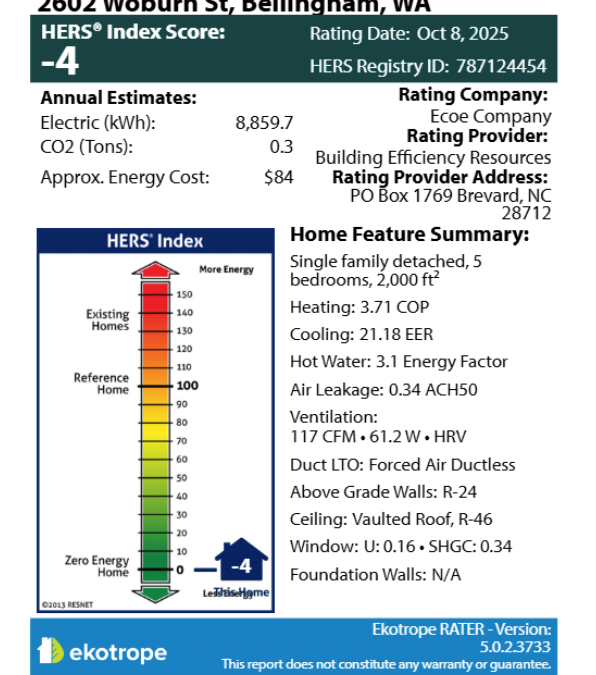
At Legend Homes, we build award winning Net Zero and Net Positive Energy Homes. A HERS rating is important in determining just how energy efficient a build is upon completion. Our most recent spec home has a HERS rating of -4, which means that this home is Net-Positive. The image depicts the HERS rating score for this recent build.
A HERS rating is essentially the gas mileage rating of a vehicle, but for a home. It is the best gauge in determining the quality of the invisible or internal workings of a home. At Legend Homes, we use EPS foam in SIP’S panel walls and roof systems to create a super insulated envelope. FAQ's about SIPS We use insulated concrete forms or ICF’s to complete the envelope in the ground around the footprint. Additionally, we use high efficiency triple pained windows as well as the most efficient electric heat pumps available in North America. We orient our homes to the sun to capitalize on solar exposure for both solar panels and solar heat gain. We look for High R-values and air seal our homes. We use a process called aero barrier, which is a process that involves pressurizing a home and misting latex particles into the air that collect and seal any unseen cracks. We use HRV’s (heat recovery ventilation system) that harvest warm conditioned air from the inside of the house and transfer it to fresh air being brought into the house. This allows for high air quality in combination with energy conservation. How We Build for Energy Efficiency
Building an energy efficient home requires so much more than simply adding solar panels to a roof. There’s a lot of buzz around Green Building and we want consumers to be aware of misleading advertising often referred to as “Greenwashing” where products are advertised as environmentally friendly or Green when they really are not. Solar power is an important piece, but only one factor in achieving a true Green Built Home. Our award-winning Green Built Homes are designed in a manner where every part of the design is geared toward achieving a Zero Energy/Net Positive outcome.
At Legend Homes, we build houses that are not only comfortable to live in, beautiful to the eye, but also inexpensive to run and better for the planet! Why Sustainable Housing Is Important
The Lynden Powerhouse Case Study, written by Talia Dreicer, was featured in this season's Master Builders Association Publication!
"The Lynden Powerhouse is a highly efficient, net-positive energy home that cultivates meaningful aging-in-place living and community connections in Lynden, Washington. Designed by Powerhouse Designs and built by TC Legend Homes, this 5-bedroom, 4.5-bath home features three distinct living areas and seamlessly merges innovative design techniques, a high-efficiency HVAC system, and automation technology to create a beautiful and comfortable home. Receiving DOE Zero Energy Ready Home, ENERGY STAR, and EPA Indoor airPLUS certifications, along with a Built Green 5-star certification, this home is a shining example of high-performance housing.
In the years leading up to their retirement, Baby Boomer couple Lee Anne Caylor and Bob Edmiston saw two potential paths. According to the couple, the choice was “a decision between lives of generativity or stagnation.” Caylor and Edmiston chose the path of generativity, focusing on creating a future where they could share time and knowledge with family, friends, and community. They started envisioning their future home, the Lynden Powerhouse, as an accessible, comfortable, and healthy living environment that would enable meaningful intergenerational living and support human connection. The COVID-19 pandemic only furthered their interest in positively impacting the lives of their family, community, and the planet, helping them refocus from their professional goals towards providing solicitude for both younger and older family members alike. The couple also saw the Lynden Powerhouse as a chance to push the high-performance housing envelope. Edmiston, a self-described “mad scientist” with a technical background and keen mind for understanding how things work, wanted to incorporate automation technology and add resiliency measures to optimize resources and reduce future financial burdens. Seeking a team that could deliver on their project goals, Caylor and Edmiston approached Powerhouse Designs and TC Legend Homes to design and build the Lynden Powerhouse."
Additionally, we were excited to hear this week that Lynden Powerhouse is one of the 2024 DOE Housing Innovation Award winners! We don't know what category the home has won yet, but we are beyond ecstatic and grateful to be receiving yet another win.
This was truly possible because of the collaboration with our incredible clients who were willing to push the envelope with us. We have the deepest appreciation for them and the innovative smart home features they created!
There seems to be a lot of confusion around Structural Insulated Panels (SIPs) in home building. In this article, we will run through the most common questions we’ve seen!
Are SIPs panels non-combustible? / Are SIPs panels fire resistant?
While SIPs can still catch fire, they are less combustible than traditional stick-framed homes. That’s, in part, due to less wood being used and because of the flame retardants used on the foam. In combination with the gypsum drywall, the whole assembly has a 1-hour fire rating. SIPs construction also does not require an attic space, which can be a fire hazard, thereby eliminating a major threat.
How are SIPs panels made?
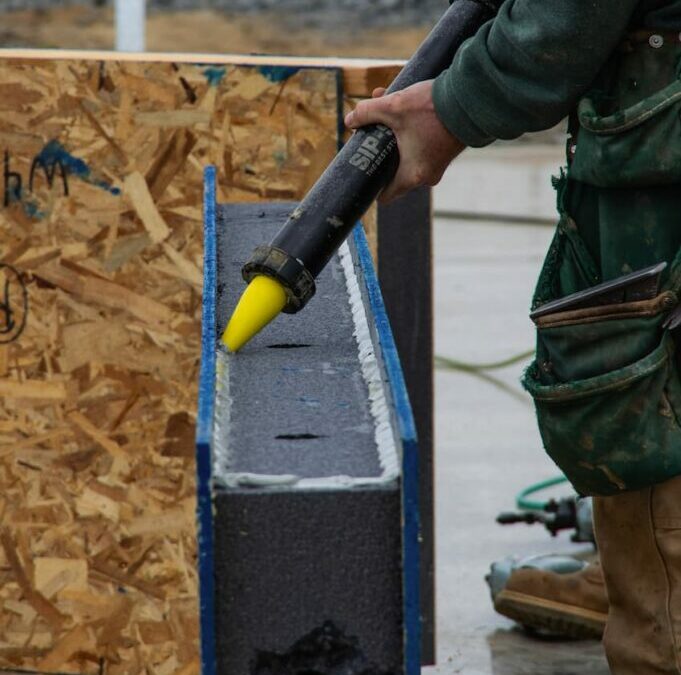
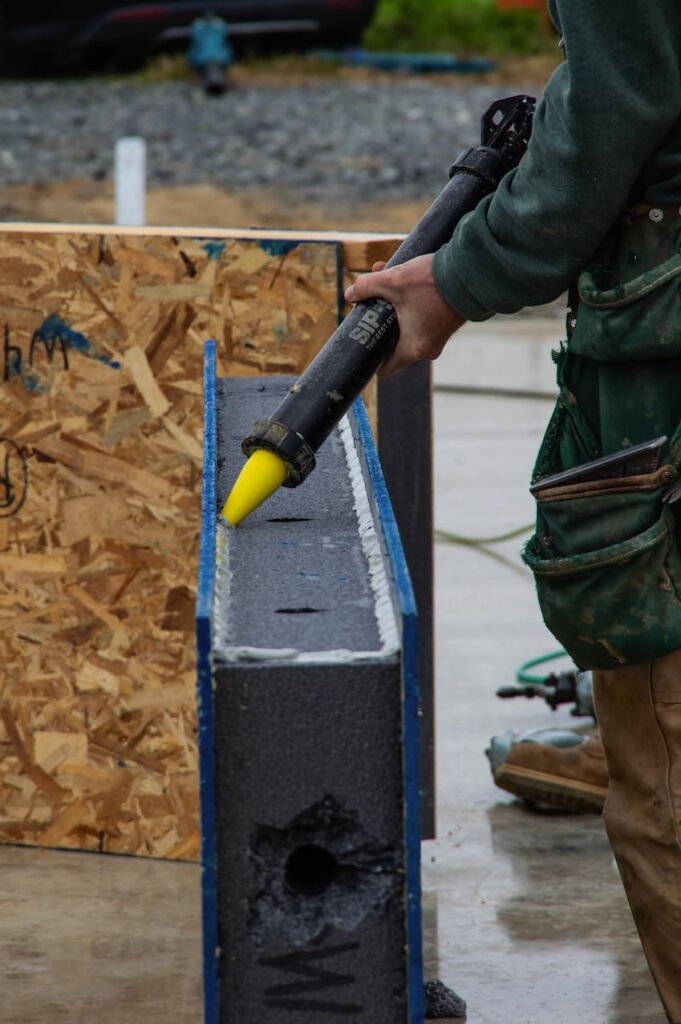
SIPs are manufactured off-site to the exact specs of the house. Each panel is made up of two OSB panels sandwiching an EPS or GPS foam core. During the manufacturing process, workers cut out each window and door opening and cut all of the pieces perfectly to size, so that when they are installed on site, they will fit together perfectly like Legos. This also means that the panel off-cuts can be recycled and reused at the manufacturing plant, reducing the overall waste!
Are SIPs panels load bearing? / Are SIPs panels structural?
Yes! SIPs can be used for the entire exterior shell of a house. According to Insulspan, “SIPs have structural properties similar to that of a steel I-beam.” In fact, SIPs are actually considered more structurally sound than traditional stick-framed homes.
Are SIPs panels environmentally friendly?
Yes! SIPs are generally considered to be more environmentally friendly than traditional stick-framed homes. That being said, SIPs can use either EPS or GPS foam cores and EPS is not a very eco-friendly option. So, it’s best to use GPS SIPs in order to lessen the home’s overall carbon footprint. Also, since SIPs are manufactured off-site, they are made to the specific dimensions of a home which reduces the waste. Any scraps produced during manufacturing are also reused. Furthermore, when shipped, the panels are tightly flat-packed together reducing fuel needed for transportation.
Can SIPs panels get wet?
Yes! SIPs are built to dry out and can withstand exposure to the elements for many months. The foam core doesn’t absorb water unless it’s physically submerged or constantly wet for a long time. In all the years we’ve built using SIPs in the rainy Pacific Northwest, we have never had an issue with the SIPs compromising due to moisture.
How long will a SIPs house last?
SIPs are a super sturdy and hardy building material. Assuming you are properly maintaining your house (i.e. replacing your roof every 30-50 years, fixing any broken siding or trim, fixing leaks as soon as they happen, etc.), then a SIPs house will last 100+ years.
Still have questions? Shoot us an email! We’d be more than happy to answer any questions you have!
To answer why sustainable housing is important, we first have to add context to the question. Each year Washington State adds roughly 35,000 to 43,000 new housing units to the market. However, to keep up with housing demands, we need to be building at least 50,000 new units each year in the state alone. Nationwide, that equates to needing upwards of 3 million new housing units each year. However, the construction industry accounts for a huge portion of the greenhouse gas emissions (GHGs) nationwide and globally accounts for roughly 37% of the CO2 emitted each year. Imagine if we made just a portion of those new homes more sustainable. The amount of CO2 we could save from being emitted into the atmosphere could have a profound impact on the future health of our planet.
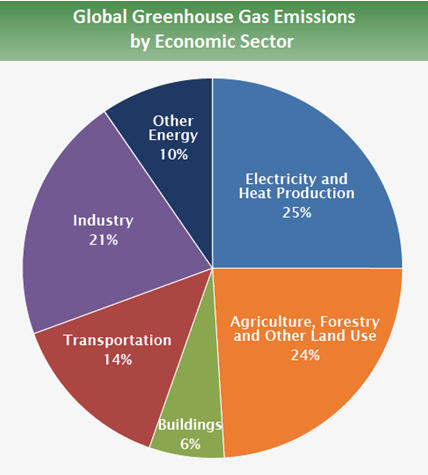
Delving even deeper, there are many different ways the construction industry impacts the overall GHG emissions. As the above chart shows, there’s a sector just for “Buildings,” which consists of the GHG emissions caused by the daily use of buildings such as cooking, heating, waste management, and providing electricity to a building. In construction, we also need to consider the GHG emissions that are produced during the process of building the homes and making all of the materials. That means that, during construction, we are also emitting GHGs from the “Industry,” “Electricity and Heat Production,” “Forestry and Land Use,” and “Transportation” sectors. Altogether, this makes up over a third of all GHG emissions.
In addition to GHG emissions, the production of every material, the deforestation to clear a jobsite, the excavation of a site – all of it has an impact on the environment as well. Deforestation for materials or land removes habitat from the ecosystem, and contributes to erosion which can impact our waterways, as well as impacts the albedo of that plot of land. Producing different materials may require mining out precious metals, minerals, or rocks which has a whole slew of negative impacts on the environment from habitat destruction to the leeching of pollutants into our waterways (think about Flint, MI). Beyond mining, the actual production and delivery of the material takes a lot of energy, produces waste, and can produce a multitude of different pollutants, not just CO2.
If you think about it, every item you choose for your home will have some level of impact on the environment. So, when we talk about sustainable housing, we are thinking about each of these materials and what choices we can make that will lessen our overall impact.
Finally, once a construction project is complete, the building itself will continue to impact the environment. Remember the “building” portion of the pie chart above? When we are building sustainably, we are also thinking about post-construction and how the home will perform sustainably. We want to make the home as energy efficient and water efficient as possible, to lessen those respective environmental impacts after move-in. Of course, the less energy the home is using while occupied, the less GHG will be emitted in order to create that energy. If renewable energy is used to power a home, then that also helps reduce the GHG emitted, but we still want to aim for decreasing the overall energy use since every energy source we use will emit GHGs in some way, some just naturally less than others. We also want to reduce the water consumption of a home while occupied, as clean water is a finite resource, and we are rapidly draining our valuable aquifers and the glaciers that supply our rivers are melting and not returning. Therefore, it’s critical that we reduce our overall water usage.
So, to answer why sustainable housing is important, we have to look at the cumulative impact of the construction industry. Simply speaking, sustainable housing helps us minimize negative environmental impacts from pre- to post-construction, not just to reduce electricity consumption or because of climate change.
At TC Legend Homes and Powerhouse Designs, we are committed to building only net zero energy homes or net zero energy ready homes and are actively working to reduce our home’s overall carbon footprint for a carbon neutral future!
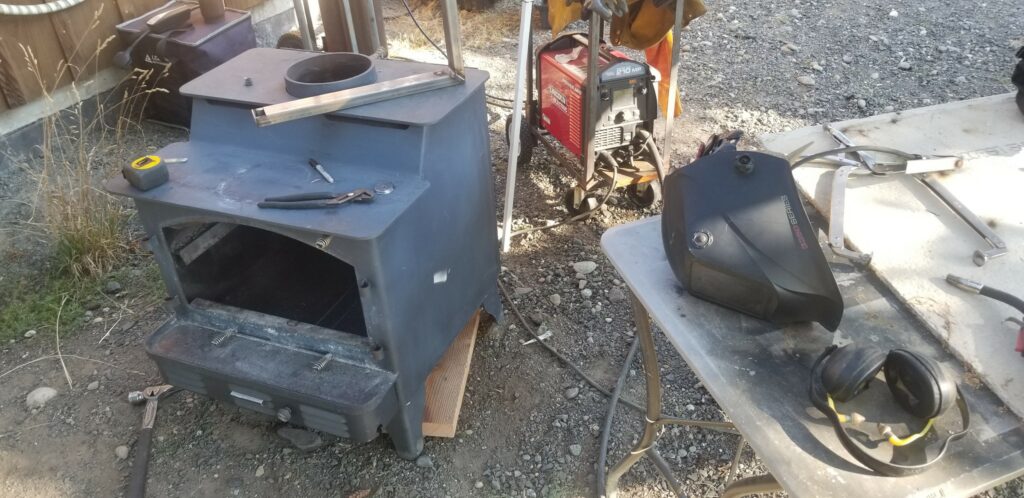
Last month Dan did some surgery on Norm's reclaimed woodstove he got from his in-laws beach cabin, giving it a secondary combustion manifold using outside air.
The idea is to make it burn the gasses released by the wood that conventional stoves waste.
Dan says, "We put in an air supply line piped from the outside to feed the fire so the fire isn't pulling the warm air from the house's envelope which helps retain warmth."
"That air supply then feeds into a manifold overtop of the fire. Dozens of little holes were drilled into a steel tubing manifold I built to spread air out through the stove. A smaller air supply splits off from the manifold at the bottom of the stove, runs across the bottom and to the front of the stove to assist with convection and combustion. Norm will then lines the walls of the stove with firebricks."
What's the point of doing all this?
So this fire could burn hotter and more efficiently!
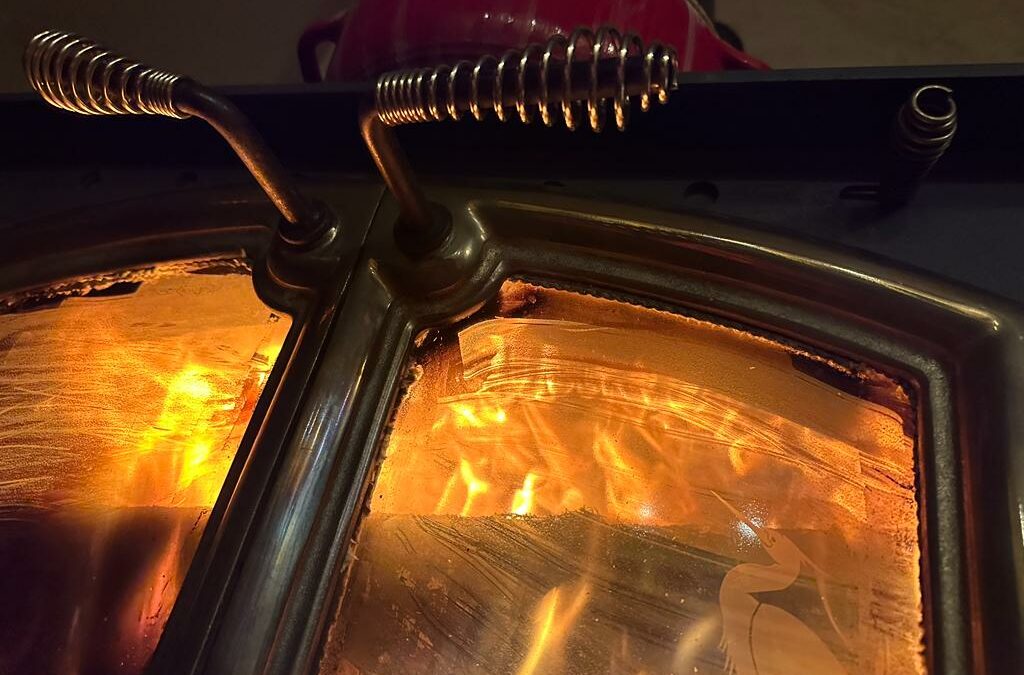
Norm reports back post-retrofit saying that "the wood stove system is working perfectly! It probably cleans the smoke up to maybe 50 percent, and burns the gasses out of the emissions as well as increasing efficiency of the burn within the burn chamber - increasing the efficiency from about 80 percent to 95 percent!"
Norm continued to say, "You can tell it is a clean burn because the glass stays clean and you have a really cool fire. The actual flame in the stove comes not just from the bottom, but it shoots down from the top - making it a really cool flame from both directions, but it's not overly hot!"
Thanks Norm & Dan for sharing your "sustainability" weekend adventures and photos of your project!



Recent Comments