
Company Logo a three peak mountain scape with an outline of a yellow sun and two blue wind wisps and Legend Homes in serif font below the mountain
Q

Design Approach

Building Process

About Legend Homes

Net Zero Education

Portfolio

News

Home

Net Zero Home Plans

Addressing Middle Housing Concerns

Addressing Middle Housing Concerns

Are you concerned about what the addition of middle housing is going to do to your neighborhood? Are you concerned about it changing the character of the houses, or make your street too busy? Maybe you are all for middle housing but just don’t want it near you. Or maybe you have no idea what middle housing is.

In this article we will explore what middle housing is and what it can look like, along with the impacts it can have on a neighborhood.
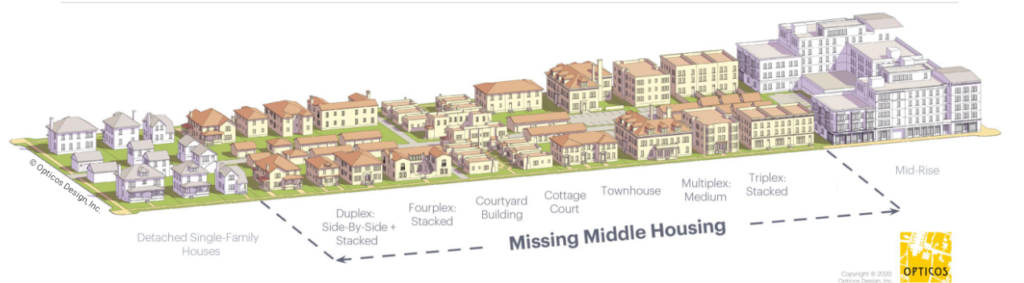
 

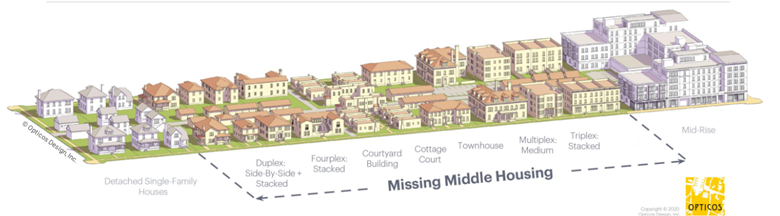
Photo Credit: Opticos Design


What is middle housing?

So, what is middle housing anyways? The WA Department of Commerce defines middle housing as “house-scale buildings with multiple units in residential neighborhoods.” That means, any housing structure that is any kind of -plex housing like a duplex or triplex, townhouses, courtyard apartments, cottage homes. “Middle” refers to middle-density housing, as opposed to large apartment complexes which are considered high-density housing, and single-family homes which is considered low-density.


What does middle housing look like?

You may still be thinking, “Well, I certainly don’t want a fourplex in my neighborhood! It’s going to stick out like a sore thumb.” Which is an understandable opinion, especially if you’ve only ever seen -plexes that look like your typical apartment complex. But they don’t have to look like that.

 With the changing needs of our population, large single-family homes are becoming more and more unnecessary and unaffordable for most people (see our last blog on the statistics). But also we don’t want to tear down beautiful historic homes, or homes that are generally in good condition. So, what about renovating the inside of these preexisting 2000+ square foot homes and splitting them into multiple single- or two-bedroom units, thereby creating a -plex house? It still keeps the same exterior integrity, matching the rest of the neighborhood and you won’t even be able to tell that there are multiple units inside. A scenario like this is also the best case in terms of carbon footprint, because you are utilizing and revitalizing the entire shell and bones of a house.
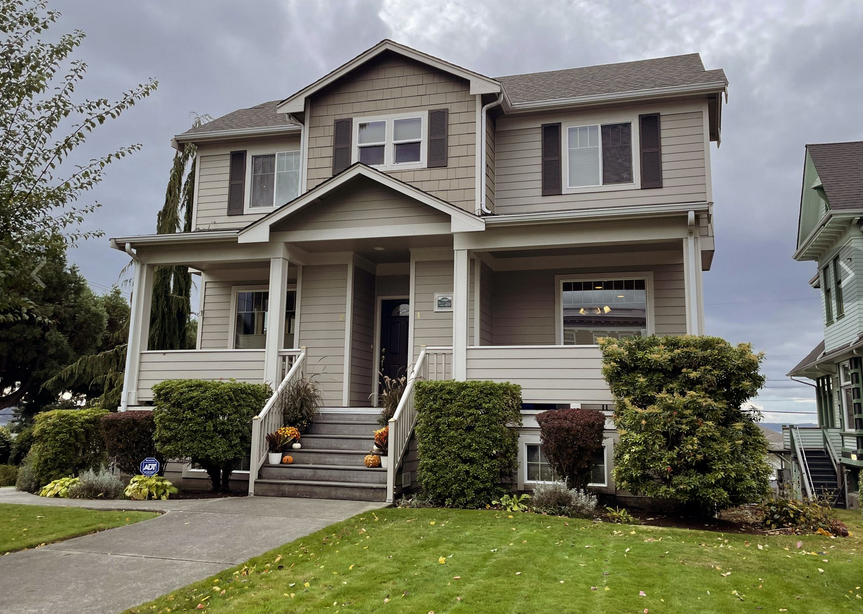
 

Photo Credit: Everett Middle Housing Resources


These inconspicuous -plex housing can be easily built in new construction as well. When you looked at the above photo, did you know that it was six-plex just looking at the exterior?

 In some areas, lots are already laid out in a way that makes housing options like cottage homes even easier to hide. Take a look at the below cottage community built in Silverdale, Washington. Add some foliage along the perimeter, and you would never know it was hidden on the lot.
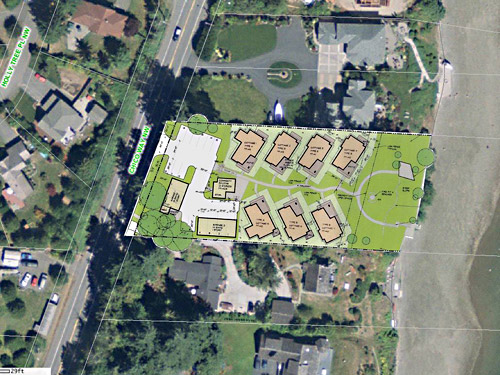
 

Photo Credit: Chico Beach Cottages – Silverdale, WA; The Cottage Company & Wenzlau Architects


Part of what will make middle housing successful is utilizing the correct types for each area. The idea is not to plop a giant multi-plex that looks like an apartment complex in the middle of a quaint neighborhood. That doesn’t make sense for anyone. But it does make sense to put a larger multi-plex on the edge of the neighborhood abut the commercially zoned areas and on busy corners. The point is to put density nearest to the city resources.
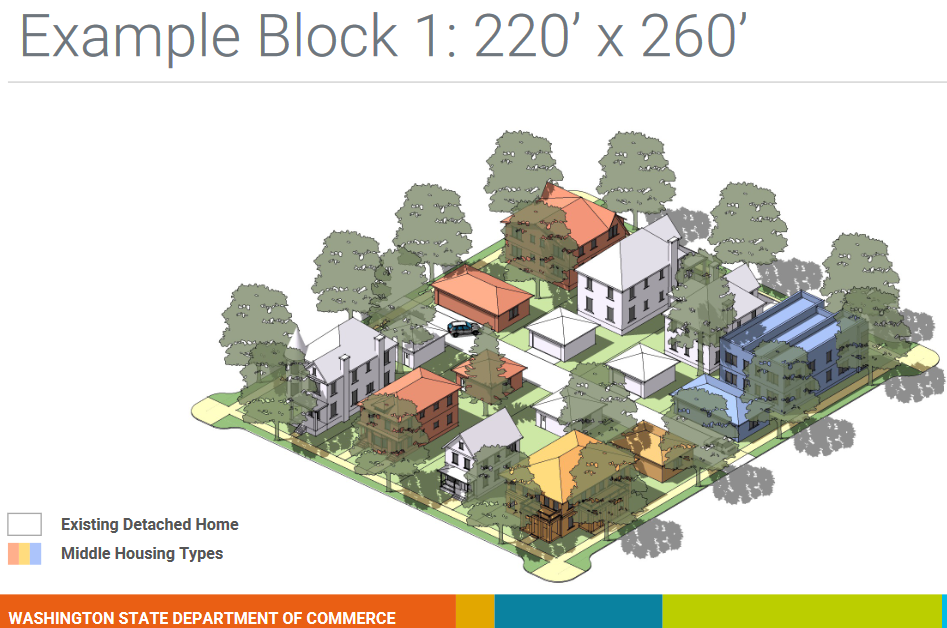
 

Photo Credit: Washington State Department of Commerce
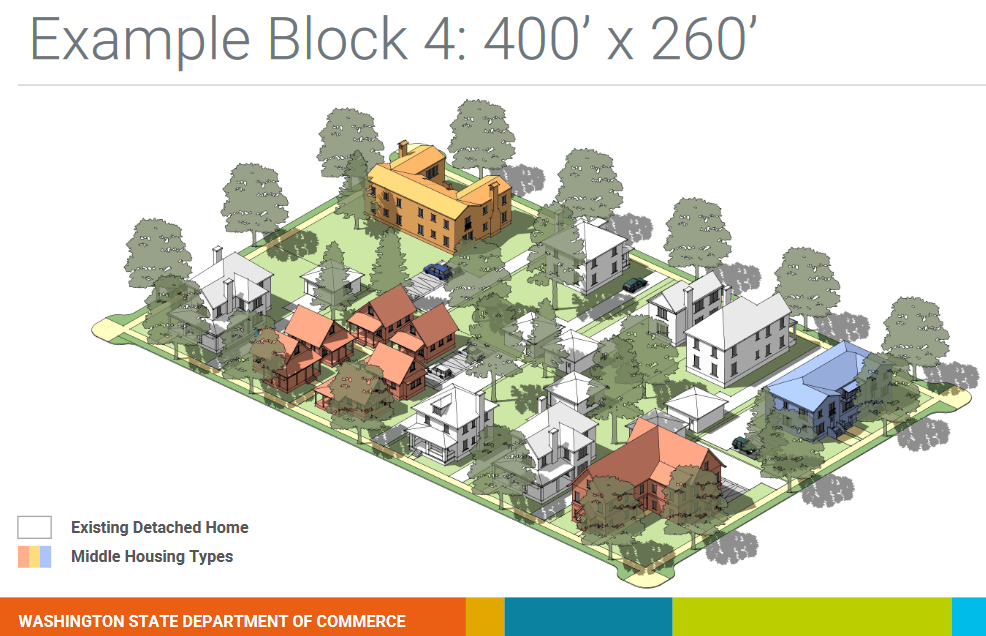
 

Photo Credit: Washington State Department of Commerce


Middle housing and parking

Perhaps you’re concerned about more vehicles on the roads in your neighborhood, either parking on the streets or causing traffic?

 Summarized by Sightline Institute, as it stands right now, the law “cap[s] mandates at no more than one parking stall per lot on lots 6,000 square feet or smaller, and at no more than two stalls per lot on lots larger than that.” And any middle housing that is within a half-mile of a major transit stop will not be subjected to any parking mandates.

 But what does this mean for you? Firstly, the point of creating such high-density housing near commercial areas and transit, is to also reduce the need for individual vehicles. When a community is walk-able and transit is readily available, less people will have cars. We are also seeing more households reducing to only one car instead of two. Take Seattle for example, whose population is ever increasing but their overall car population has remained stable for the past several years.
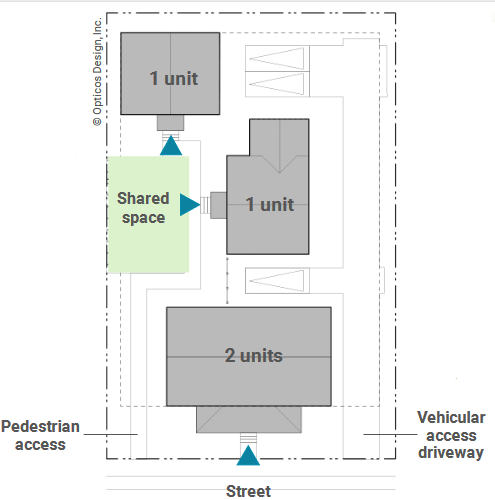
 

Photo Credit: Washington State Department of Commerce & Opticos Design


Now, for the lots that will mandate parking, if we are looking at what most likely is going to end up in your neighborhood, a duplex, triplex, fourplex or six-plex, that means they will be required to have two, three, four or six parking spaces respectively. For a duplex and even triplex, that’s not going to be more parking than a typical single-family home already has in many cases. And looking at the site plan above from Opticos Design, the parking spots can be easily hidden from street view. Fourplexes and six-plexes will be in a similar boat, where parking could potentially be hidden, or it may end up right off the street. And while that won’t be as nice to look at, think about how many houses have garages and driveways already at the front of the house. It won’t be out of place to have that much flatwork. Moreover, because of the required parking spaces, there isn’t likely going to be more vehicles parked on the street, as the households moving into the middle housing are typically smaller and therefore won’t have multiple cars.

 Overall, the number of extra vehicles on the road is going to quite minimal taking all of the above into account. So there isn’t anything to worry about when it comes to cars.


Conclusion

If you are still thinking, “Well, who would even WANT to live in these?” Just remember that not every type of housing is for every person, but there is a market for every type of housing you could think of, whether it’s something you, personally, would want to live in or not. And with housing being as expensive and unaffordable to purchase these days as it is, there are many people who just want something they can afford and put equity into that meets their minimum needs. Which middle housing can do, while increasing many people’s quality of life. Middle housing a crucial step towards ensuring younger and older generations alike have reliable housing.

 As housing-for-everyone advocates, TC Legend Homes and Powerhouse Designs strives to educate the public on these important issues while providing healthy, net-zero, carbon neutral budget homes in a effort to not only help the housing crisis, but provide top-performing homes.


To further discuss middle housing and the path forward for our community, or to get started on your very own project, contact us today!

12 Shocking Housing Statistics You Should Know!

12 Shocking Housing Statistics You Should Know!

 When talking about where we need to go next in the housing industry, it's important to look at where we are currently and what our trajectory is. This will help us determine the needs of our current and future communities and what we can do to help them. To do this, let's look at 12 housing statistics.

Housing Statistics for the United States:

1). “In 2022, about 29% of all US households were one-person households

As our one-person households increase globally, we are no longer needing as many large single-family residences, rather we are needing more multi-family and middle housing options.

2). By 2030 1 in 5 Americans will be 65+.

With our aging population, there is an increasing need for smaller and more affordable homes for the older population to live in that cannot afford to live in large single-family residences. This also means that the housing being built should consider universal design methods to make the homes accessible to folks using mobility aids and with various disabilities.

3). By 2025 up to 85% of households will not have children.

A staggering number to look at! Regardless of why people are choosing not to have children these days, it means the population does not need as big of homes to house a family of 3+ anymore. The needs and priorities of our population are rapidly changing, so our housing needs to reflect that.


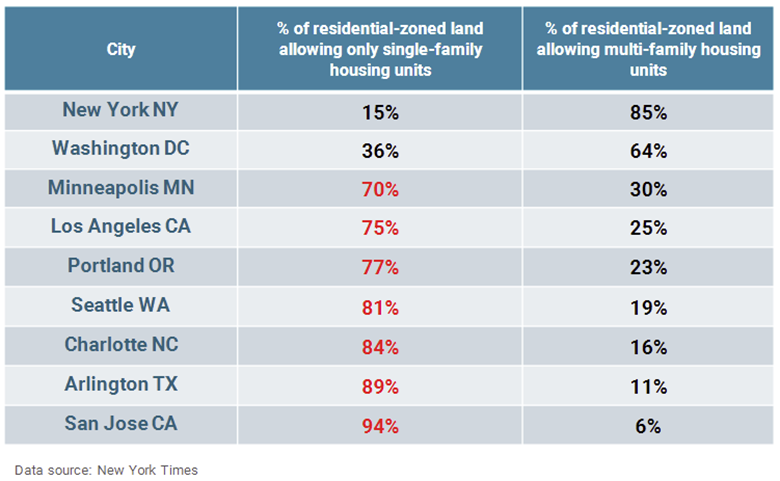
4). As much as 80% or more of many cities is zoned exclusively for Single Family.

And yet the laws are still lagging behind and only allowing single-family residences to be built. An overhaul of the legislature is greatly need in order to legalize multi-family/middle housing.

5). Millennials are looking for walkable living and MMH (missing middle housing).

Studies even show that this generation of renters and home buyers aren't looking for the traditional single-family home. They are wanting middle housing and housing in communities that are walkable--where they can walk to the grocery store, a park, a restaurant, the gym. But the zoning across most US cities doesn't allow for this.

Housing Statistics for Bellingham & Whatcom County:

6). Bellingham is expected to have an average population growth of 1,350 people per year in the next 20 yrs.

This may not seem like a lot, but when you think about the fact that our population is currently at just over 93k people and the vacancy rate is just under 2% (we are in need of more housing already), then the reality of the amount of housing we need to build in the next 20 years to not just keep up with the growth, but also make up for the lack of availability already.

7). The median income for Bellingham is around $60,000/yr.

This means that 50% of Bellingham residents make $60k/yr or less and the other 50% of residents make $60k/yr or more. This becomes more important when knowing the following facts.


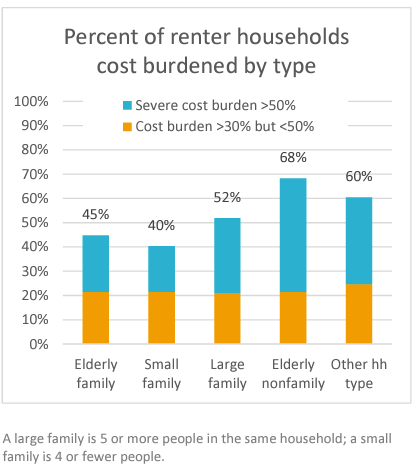
8). “In Bellingham, 24% of homeowners and 56% of renters are cost burdened.”

If 54% of renters are cost burdened just renting, then that means the likelihood for more than half of our renters to be able to purchase a home is incredibly low. But homeownership is the best way to gain equity. So more than half of renters are stuck in the perpetual cost burdened cycle until something changes that makes housing more affordable or they are somehow able to make enough to purchase a home. But looking at the following facts, you'll see that's even harder than in sounds.

9). “In the second quarter of 2019, the homeownership rates for white, Black, and Latino households were 73.1 percent, 40.6 percent, and 46.6 percent respectively – the largest differentials in fifty years.”

It's important to note that of those that own homes in Whatcom County, it is mostly white individuals, leaving minorities stuck renting or houseless. Showing that while the issue of housing affordability is affects everyone, it disproportionally affects minorities.


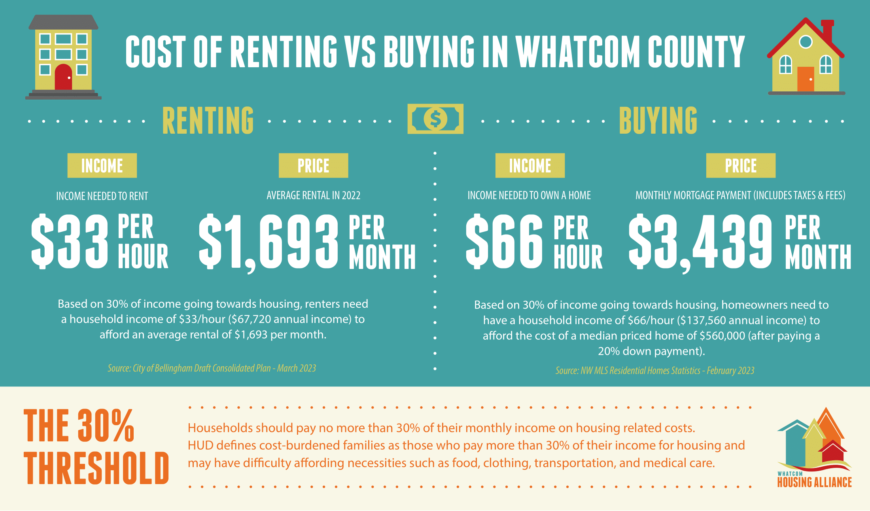
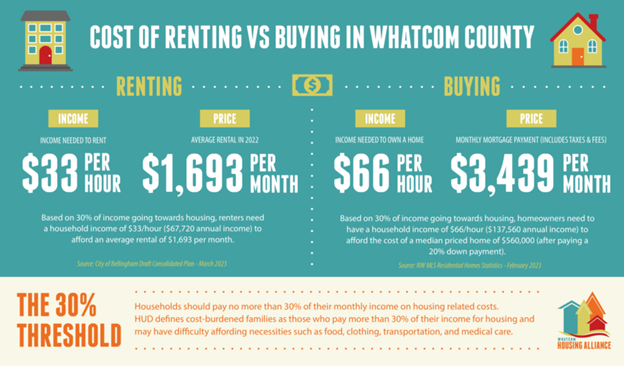
10). In 2022, the average rental cost was $1,693/mo; In order to afford this, a renter would need to make $33/hr or $67,720/yr. (WHA Cost of Renting Vs Buying in Whatcom County

According to 2020 Census data, 71% of Bellingham households are made up of only 1-2 people. Looking back at the median income for Bellingham (which is $60k/yr), we can see that the average rental is not affordable for a huge portion of our community and it shows why 56% of renters are cost burdened.

11). The average mortgage payment is $3,439/mo; In order to afford this, a homeowner would need to make $66/hr or $137,560/yr. (WHA Cost of Renting Vs Buying in Whatcom County)

We saw that 24% of homeowners are cost burdened, and its more shocking that more aren't cost burdened when looking at the average mortgage payment and knowing only 50% of the community makes $60k or more. Even in a household of two making the median income wouldn't be able to afford the average mortgage payment.

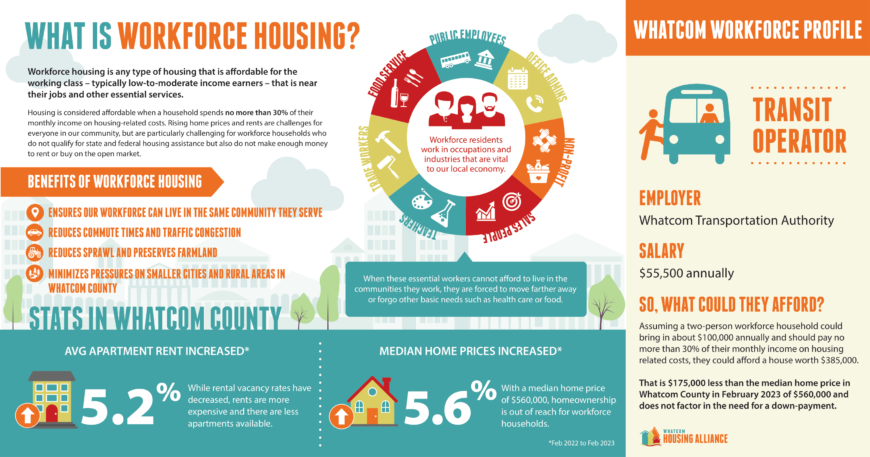
12). The median home price in Whatcom County in February 2023 was $560,000; However, a couple making a collective $100,000/yr could only afford a house worth $385,000. (WHA What is Workforce Housing?)

In order for housing prices to reduce to a level that the typical Bellingham or Whatcom County resident can afford, we need to focus on building middle housing which is smaller and more affordable. It also allows us to build more units with more density, which will help address the vacancy rates and growing population. Middle housing is a great option for our aging population as well, as they can still live in the city where there are public facilities, and it is less expensive. Middle housing will also cater to our changing population dynamics as we see more and more childless and one-person households.


Thankfully Washington state recently passed HB 1110 which legalizes middle housing and HB 1337 which makes it eases the restrictions on ADU's. The city of Bellingham is also working hard to implement these at city-level for our near future.


As housing-for-everyone advocates, TC Legend Homes and Powerhouse Designs strives to educate the public on these important issues while providing healthy, net-zero, carbon neutral budget homes in an effort to not only help the housing crisis, but provide top-performing homes.

To further discuss middle housing and the path forward for our community, or to get started on your very own project, contact us today!
ADU Reform at the City & State Levels

ADU Reform at the City & State Levels

Currently both Washington State and the City of Bellingham are proposing changes to the current ADU regulations and process. From the outside it may seem complicated and long winded, but we’ve been keeping up to date with it, so you don’t have to!

But first let’s back up. Why is this such an important topic? All over the state, including Bellingham, we are seeing both a housing shortage and unaffordable costs for both renters and home buyers. Accessory Dwelling Units, aka ADUs, are seen as a tool to help fight both of these issues. While ADUs are certainly not the only answer to the affordability crisis, they are a start to addressing the issue. ADUs are, however, thought to have a much bigger effect on addressing the housing shortage. According to 2020 Census data, 71% of Bellingham households are made up of only 1-2 people. This means that medium and large sized single-family residences are not what Bellingham needs in order to solve the housing crisis. It needs ADUs and other forms of middle housing. As it stands right now, State and City regulations make it more difficult than it needs to be in order to permit and build ADUs (and middle housing). So, at both levels reform to the current ordinances are being proposed in order to ease these restrictions, allowing for more ADUs to be built and with less needless regulations.

Summary

-At the State level: There were two bills currently addressing changes to ADU regulations for the entire state. These are bills HB 1276 and HB 1337. Bill HB 1276 is essentially the watered-down version of HB 1337. However, bill HB 1337 recently passed out of the House Housing Committee with no amendments. Next steps for HB 1337 are to pass through the Rules committee and then through the Floor.  Organizations who support HB 1337 vocally as of the first hearing include Homes4WA, Sightline Institute, FutureWise, League of Women Voters, Habitat For Humanity, American Farmland Trust, Kirkland Planning Commission and a handful of architects and builders. TC Legend also supported HB 1337 over HB 1276.

-At the City level: There is one ordinance being proposed to amend Bellingham Municipal Code Titles 20 and 21 regarding ADU regulations and processes. This ordinance is essentially bill HB 1337 specifically for Bellingham. Whatcom Housing Alliance’s recommendations to the changes being put forth have been the main reference point for many community members and organizations. You can find their recommendations HERE. After the first hearing, City Council has sent the ordinance back to the Planning Commission for revisions for further clarification, data and feedback. Once the Planning Commission has finished this review, it will be presented to City Council again. They may need to revise again, or they will vote at that time. Once the ordinance passes through City Council it will take a bit of time for the Planning Commission to update their current ADU ordinance and implement the changes. However, assuming all goes smoothly, we should see the changes being implement most likely by the end of the year.

Key Components

-Remove Owner Occupancy Requirements: This is arguably the most contested topic in the City level ADU reform. The amendment states that the owner of the ADU is no longer required to live in either the main SFR or the ADU while renting and can therefore rent both out at the same time. On one hand, this would allow flexibility for homeowners who need to go out of town for extended period of time, or are elderly, and would increase housing availability. On the other hand, if there are not restrictions added to this amendment, it could open up Bellingham to more large-scale investors, taking control of our rental market and potentially further pricing out locals.

-Remove Off-Street Parking Requirements: The requirement of off-street parking, while may seem necessary to some, is typically not necessary or feasible on infill lots which are already near shopping centers and bus stops. Cities are using this as a technique to incentivize alternative modes of transportation, while also recognizing the limitations that come with infill lots.

-Condo-ization of ADU’s: Opening ADU’s to purchase is thought to help homeownership among the many small households that are currently struggling to afford the houses currently on the market and are therefore forced to remain renting. It is debatable as to whether this would create an affordable option or not. But the best way to create an equitable housing market is for more homeownership among the lower and middle class.

-Removing Appearance Requirements: Currently there are height restrictions and appearance requirements on DADU’s stating that they must match the aesthetic of the neighborhood, however current SFR’s are not even held to that same standard. The amendment would also allow the height of the ADU to increase to 25’ from 20’. There are some arguments to increase this limit even more or get rid of the restriction altogether to be able to accommodate a second floor and higher ceilings.

Other Bills To Watch

Washington State has at least 50 proposed housing bills. So if you want to take action and help sculpt the trajectory of housing in our state, look out for these bills and submit your commentary to the Housing Committee.

Among those proposed housing bills, HB 1110 / SB 5190 should be highlighted as they are important in legalizing middle housing.

If you are a renter, then you’ll want to watch out for HB 1124 which increases the timeframe that landlords must notify tenants of any increases to rent. There are also HB 1389 / SB 5435 which puts a cap on rent increase to either the rate of inflation or 3% (whichever is greater).

For more information on the State and City level ADU reform, see the following related articles.

-50 Housing Bills To Watch: https://www.sightline.org/2023/02/15/50-housing-bills-to-watch-in-olympia-right-now/?utm_source=Sightline+Newsletters+II&utm_campaign=ac6344b2dc-EMAIL_CAMPAIGN_2019_11_22_09_02_COPY_01&utm_medium=email&utm_term=0_3e1b0f73ac-ac6344b2dc-296546103

-Comparison of HB 1276 and HB 1337: https://www.sightline.org/2023/01/21/washington-bill-would-boost-in-law-apartments-throughout-the-state/#:~:text=HB%201276%3A%20Allows%20one%20attached,key%20reforms%20the%20bill%20requires).

-Recap of HB 1276 and HB 1337 Hearing: https://whatcomhousingalliance.org/bellingham-adu-public-hearing-recap/

-Washington State Legislature Bill Lookup: https://app.leg.wa.gov/billinfo/